
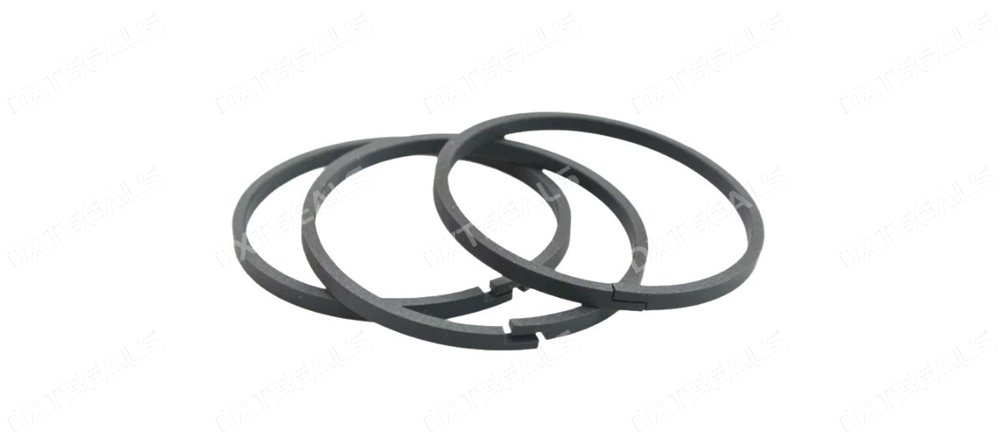
Guide components play an important role in hydraulic cylinders, pneumatic cylinders, and other reciprocating equipment. They support moving components, absorb radial and side loads, and prevent direct metal-to-metal contact between pistons, rods, and cylinder walls.
Among the available guiding solutions, PTFE bronze guide wear strips have become increasingly popular because of their low friction, excellent wear resistance, and high load-bearing capacity. Traditional guide rings, particularly metal guide rings, can still be suitable for certain applications, but they may have limitations related to friction, weight, lubrication, and cylinder surface wear.
Understanding the differences between PTFE bronze guide wear strips and traditional guide rings can help engineers select the most appropriate guiding solution for specific operating conditions.
What Is a PTFE Bronze Guide Wear Strip?
A PTFE bronze guide wear strip is a guiding component manufactured from PTFE reinforced with bronze filler. It is installed in a groove on a hydraulic piston or rod to provide support and maintain alignment during reciprocating movement.
The PTFE base provides:
- Low friction
- Self-lubricating characteristics
- Excellent chemical resistance
- Smooth movement
The bronze filler improves:
- Mechanical strength
- Wear resistance
- Load-bearing capacity
- Thermal conductivity
- Dimensional stability
This combination makes bronze-filled PTFE particularly suitable for demanding hydraulic applications.
What Are Traditional Guide Rings?
Traditional guide rings can be manufactured from various materials, including metals and engineering plastics. Metal guide rings made from bronze, steel, or other alloys have traditionally been used to support pistons and rods in hydraulic cylinders.
Their main function is similar to that of PTFE guide strips: preventing direct contact between moving metal components and absorbing lateral forces.
However, the material and design of a traditional guide ring can significantly affect friction, wear, lubrication requirements, and cylinder performance.
PTFE Bronze Guide Strips vs Traditional Guide Rings
The two solutions differ in several important performance characteristics.
| Feature | PTFE Bronze Guide Wear Strips | Traditional Metal Guide Rings |
|---|---|---|
| Friction | Very Low | Moderate to High |
| Self-Lubrication | Excellent | Limited |
| Wear Resistance | Excellent | Good to Excellent |
| Side Load Capacity | High | High |
| Weight | Lightweight | Heavier |
| Corrosion Resistance | Excellent | Material Dependent |
| Cylinder Surface Protection | Excellent | Good |
| Noise | Low | Higher |
| Machining Flexibility | High | Moderate |
| Installation | Simple | Depends on design |
Actual performance depends on the specific material grade, guide design, dimensions, load, speed, lubrication, and operating environment.
1. Friction Performance
One of the biggest advantages of PTFE bronze guide strips is their low coefficient of friction.
PTFE naturally provides excellent sliding properties, allowing pistons and rods to move smoothly with relatively low resistance.
This can result in:
- Lower starting friction
- Smoother reciprocating movement
- Reduced energy loss
- Less heat generation
- Lower wear on mating surfaces
Traditional metal guide rings generally have higher friction and may require appropriate lubrication to achieve smooth movement.
2. Wear Resistance
Guide components are exposed to repeated sliding movement and side loads during cylinder operation.
Bronze-filled PTFE provides excellent wear resistance while maintaining low friction. The bronze reinforcement improves the mechanical strength of the PTFE material and makes it suitable for heavier loads than many unfilled PTFE materials.
Traditional metal guide rings can also provide excellent wear resistance, especially under heavy loads. However, the hardness of the guide material must be carefully matched to the cylinder surface to prevent scoring or excessive wear.
3. Load-Bearing Capacity
Side loads can occur when hydraulic cylinders are subjected to uneven loading or misalignment.
PTFE bronze guide strips are designed to distribute these loads across the guide surface, helping maintain piston and rod alignment.
Bronze reinforcement improves the compressive strength and load-bearing capability of PTFE, making this material suitable for many heavy-duty hydraulic applications.
For extremely high-load applications, however, a metal guide solution may still be preferred depending on the cylinder design and operating conditions.
4. Protection of Cylinder Surfaces
A properly selected guide material should protect the cylinder bore and rod from excessive wear.
PTFE bronze guide strips provide a relatively soft sliding interface compared with hardened metal components. This can reduce the risk of damaging precision-machined cylinder surfaces.
This is particularly important for hydraulic cylinders because damage to the cylinder bore or piston rod can lead to:
- Seal wear
- Hydraulic leakage
- Reduced efficiency
- Increased maintenance costs
5. Weight and Equipment Efficiency
PTFE guide strips are significantly lighter than many traditional metal guide components.
The reduced weight can be beneficial in applications where overall equipment weight is important, such as:
- Mobile hydraulic equipment
- Construction machinery
- Agricultural machinery
- Automated systems
Lightweight guide components can also simplify installation and replacement.
6. Corrosion Resistance
PTFE provides excellent resistance to many chemicals, hydraulic fluids, and environmental conditions.
Bronze-filled PTFE guide strips are therefore suitable for applications where corrosion resistance is important.
Metal guide rings may require specific alloy selection or additional protection depending on the operating environment.
For equipment exposed to water, chemicals, or corrosive media, material compatibility should always be evaluated before selecting a guide component.
7. Lubrication Requirements
PTFE has natural low-friction and self-lubricating characteristics. Bronze-filled PTFE guide strips can therefore operate effectively with relatively low lubrication requirements, depending on the application.
Traditional metal guide rings may depend more heavily on lubrication to reduce friction and prevent excessive wear.
However, lubrication requirements should always be determined based on the specific material, speed, load, temperature, and operating medium.
Applications of PTFE Bronze Guide Wear Strips
PTFE bronze guide strips are widely used in:
Hydraulic Cylinders
They provide piston and rod guidance while absorbing side loads and preventing metal-to-metal contact.
Construction Machinery
Typical applications include:
- Excavators
- Wheel loaders
- Cranes
- Bulldozers
- Road construction equipment
Industrial Hydraulic Equipment
They are commonly used in:
- Hydraulic presses
- Injection molding machines
- Industrial automation systems
- Material handling equipment
Pneumatic Systems
The low friction characteristics of PTFE make bronze-filled guide strips suitable for pneumatic cylinders and other reciprocating equipment.
When Are Traditional Guide Rings Still a Good Choice?
PTFE bronze guide strips are not automatically the best solution for every application.
Traditional metal guide rings may be preferred when:
- Extremely high radial loads are present.
- The application requires very high mechanical strength.
- Operating temperatures exceed the practical range of the selected PTFE compound.
- The existing cylinder design specifically requires a metal guide.
- The equipment operates under severe mechanical impact.
Material selection should always be based on actual operating conditions rather than simply choosing one material for all applications.
How to Choose the Right Guide Solution
Before selecting a PTFE bronze guide strip or traditional guide ring, evaluate:
- Piston and rod diameter
- Groove dimensions
- Radial load
- Operating pressure
- Reciprocating speed
- Operating temperature
- Lubrication conditions
- Hydraulic fluid compatibility
- Cylinder surface hardness
- Required service life
For demanding applications, an experienced manufacturer can help determine the appropriate material, profile, and dimensions.
Custom PTFE Bronze Guide Strip Manufacturing
Many hydraulic cylinders require non-standard guide dimensions. Custom manufacturing allows guide strips to be produced according to specific equipment requirements.
Custom services may include:
- OEM manufacturing
- Production according to drawings
- Custom width and thickness
- Custom material formulations
- Guide strips for non-standard grooves
- Prototype production
- Small and large production runs
Precision machining and strict dimensional inspection ensure proper installation and reliable guiding performance.
Conclusion
PTFE bronze guide wear strips offer an excellent combination of low friction, wear resistance, load-bearing capability, chemical resistance, and lightweight construction. Compared with many traditional metal guide rings, they can provide smoother movement, reduced cylinder surface wear, and lower maintenance requirements.
Traditional guide rings remain valuable for applications involving extremely high loads, severe mechanical conditions, or specific equipment designs. The best solution depends on the operating environment, load, speed, temperature, lubrication, and cylinder construction.
For hydraulic and pneumatic systems requiring a balance of low friction, reliable guidance, and long service life, precision-manufactured PTFE bronze guide wear strips are a highly effective guiding solution.