
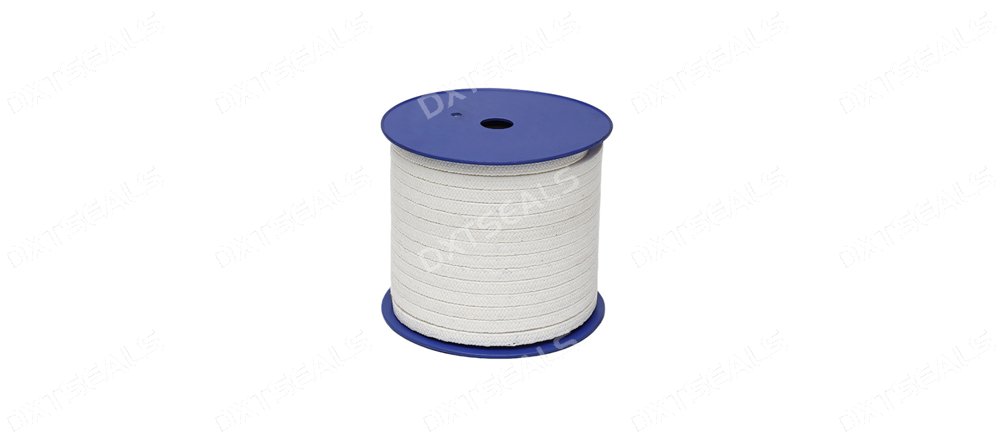
Valves are essential components in industrial piping and fluid-control systems. To prevent leakage around the valve stem, many valves use gland packing as a dynamic sealing element. Among the available packing materials, PTFE valve packing is widely used because of its excellent chemical resistance, low friction, and good sealing characteristics.
PTFE, or polytetrafluoroethylene, is a fluoropolymer with a combination of chemical resistance and low-friction properties that makes it suitable for many demanding sealing applications.
PTFE valve packing can be used in industrial valves handling water, chemicals, solvents, and other compatible media. Depending on the valve design and operating conditions, PTFE packing can be supplied in different constructions, cross-sections, densities, and reinforcement configurations.
What Is PTFE Valve Packing?
PTFE valve packing is a packing material installed around a valve stem inside the valve's stuffing box. The packing is compressed by a gland or packing follower to create a sealing interface between the stationary valve body and the moving valve stem.
The basic sealing principle is:
- PTFE packing is installed around the valve stem.
- The gland compresses the packing inside the stuffing box.
- The packing conforms to the stem and stuffing-box surfaces.
- Compression creates a sealing barrier.
- The valve stem can continue to move while the packing controls leakage.
The actual sealing performance depends on the packing design, valve geometry, stem surface condition, gland pressure, temperature, pressure, and process medium.
Material Properties of PTFE
Excellent Chemical Resistance
One of the most important characteristics of PTFE is its broad resistance to many chemicals.
PTFE valve packing can therefore be considered for applications involving:
- Acids
- Alkalis
- Solvents
- Water
- Many corrosive chemicals
- Chemical process fluids
Chemical compatibility should always be checked against the actual fluid, concentration, temperature, and operating conditions.
Very Low Friction
PTFE has a very low coefficient of friction compared with many conventional sealing materials.
This property is particularly valuable for valve stem packing because the valve stem must move through the packing during opening and closing.
Low friction can help reduce:
- Stem friction
- Operating torque
- Packing wear
- Heat generation caused by friction
The actual valve operating torque depends on the complete valve design and should not be attributed to the packing material alone.
Low Water Absorption
PTFE has very low water absorption, allowing PTFE packing to maintain stable characteristics in many wet operating environments.
This makes it suitable for various water and fluid-control applications.
Good Thermal Stability
PTFE maintains useful sealing characteristics across a relatively broad temperature range. However, PTFE packing should always be selected according to the specific product's rated temperature and the actual service conditions.
Continuous high-temperature applications may require alternative materials such as graphite or specially designed composite packing.
Non-Stick Surface Characteristics
PTFE has a low surface energy and non-stick characteristics. These properties can help reduce adhesion between the packing and valve stem and contribute to smoother valve operation.
PTFE Valve Packing Sealing Performance
Static and Dynamic Sealing
Valve stem packing is primarily a dynamic sealing application because the valve stem moves during operation.
The packing must maintain contact with the stem while accommodating repeated movement. Proper gland compression is important for balancing leakage control against excessive friction.
Low Friction Operation
The low-friction characteristics of PTFE can help reduce resistance to valve stem movement.
This can be particularly useful for valves that are frequently operated or require relatively low operating torque.
Chemical Sealing Performance
PTFE packing is frequently selected where chemical resistance is more important than the high-temperature capability offered by graphite-based packing.
It can provide a reliable sealing solution for many chemical process valves when the operating temperature and pressure are within the product's specified range.
Wear Resistance
Packing wear depends on multiple factors, including:
- Valve stem surface finish
- Stem movement speed
- Packing compression
- Operating temperature
- Process medium
- Pressure
- Packing construction
- Valve alignment
A properly selected PTFE packing construction can provide reliable service in suitable valve applications.
Common Types of PTFE Valve Packing
PTFE valve packing is available in different constructions depending on the application.
Pure PTFE Packing
Pure PTFE packing uses PTFE as the primary sealing material.
It is often selected where chemical resistance and low friction are the main requirements.
Expanded PTFE Packing
Expanded PTFE packing uses expanded PTFE material to create a flexible packing structure.
It can conform well to irregularities in the stuffing box and valve stem while maintaining the chemical resistance associated with PTFE.
PTFE Braided Packing
Braided PTFE packing is manufactured by braiding PTFE yarn or fibers into a square or other cross-sectional structure.
The construction can provide flexibility and mechanical stability for valve and pump applications.
Lubricated PTFE Packing
Some PTFE packing products are supplied with specialized lubricants or additives to improve installation and operating characteristics.
The specific formulation depends on the intended application.
Reinforced PTFE Packing
PTFE packing can also be reinforced with other fibers or materials to improve mechanical strength, extrusion resistance, or dimensional stability.
The appropriate reinforcement depends on the operating conditions and equipment design.
PTFE Valve Packing vs Graphite Packing
PTFE and graphite are both widely used packing materials, but they have different performance characteristics.
| Property | PTFE Valve Packing | Graphite Packing |
|---|---|---|
| Chemical Resistance | Excellent for many media | Good to excellent depending on environment |
| Friction | Very low | Low |
| Temperature Capability | High, depending on product | Very high, depending on product and environment |
| Water Resistance | Excellent | Good |
| Thermal Stability | Good | Excellent |
| Typical Advantage | Chemical resistance and low friction | High-temperature performance |
| Typical Applications | Chemical, water, general industrial valves | Steam, high-temperature, power and process valves |
PTFE is often preferred when low friction and chemical resistance are important. Graphite is commonly considered when high-temperature service is the dominant requirement.
Neither material should be selected solely by temperature or chemical resistance. The complete operating environment must be evaluated.
Typical Applications of PTFE Valve Packing
Chemical Processing Valves
PTFE valve packing is widely used in chemical processing equipment because of its resistance to many aggressive chemicals.
It can be used in valves controlling acids, alkalis, solvents, and other compatible process fluids.
Water Treatment Valves
Water treatment systems frequently contain valves that require reliable stem sealing.
PTFE packing can be used in suitable water treatment applications where low friction and chemical resistance are beneficial.
Industrial Water Systems
PTFE valve packing can be used in valves for industrial water circulation, process water, and other compatible fluids.
Pharmaceutical and Process Equipment
In suitable applications, PTFE packing can be considered where chemical resistance and clean sealing characteristics are important.
The exact material and packing construction should be selected according to the equipment and applicable industry requirements.
Solvent and Chemical Handling
PTFE packing is frequently considered for valves handling compatible solvents and chemical fluids because of the material's broad chemical resistance.
Factors Affecting PTFE Valve Packing Performance
Valve Stem Surface Finish
The condition of the valve stem directly affects packing performance.
A damaged, rough, corroded, or improperly finished stem can accelerate packing wear and increase leakage.
Stuffing Box Dimensions
Correct packing dimensions are essential. Excessively loose packing may not seal properly, while excessive compression can increase stem friction and operating torque.
Operating Temperature
Temperature affects the physical characteristics of the packing and should be considered when selecting the material.
Operating Pressure
Higher pressure can increase the sealing requirements placed on the packing.
The packing design should be appropriate for the actual valve pressure and process conditions.
Valve Operating Frequency
Valves that cycle frequently place greater demands on dynamic packing performance than valves that remain in a fixed position for long periods.
Process Medium
Chemical compatibility must be evaluated according to the actual fluid and its concentration, temperature, and pressure.
How to Select PTFE Valve Packing
A practical selection process can include the following steps.
Step 1: Identify the Valve Type
Determine whether the packing is being used in a gate valve, globe valve, ball valve, control valve, or another valve design.
Step 2: Confirm Valve Stem Dimensions
Measure the valve stem and stuffing-box dimensions to determine the appropriate packing cross-section.
Step 3: Check the Process Medium
Identify the fluid being sealed and verify its compatibility with PTFE.
Step 4: Check Temperature and Pressure
Confirm both normal and maximum operating temperature and pressure.
Step 5: Consider Valve Movement
Determine whether the valve operates occasionally, frequently, or continuously.
Step 6: Select the Packing Construction
Choose between pure PTFE, expanded PTFE, braided PTFE, lubricated PTFE, or reinforced PTFE based on the actual application.
Step 7: Confirm Installation Requirements
Correct packing installation and gland adjustment are essential for reliable sealing performance.
PTFE Valve Packing for OEM and Replacement Applications
Industrial valve manufacturers and maintenance teams may require both standard and customized packing solutions.
Standard PTFE valve packing can be supplied in commonly used dimensions for maintenance and replacement applications.
For non-standard equipment, customized PTFE packing can be manufactured according to:
- Valve drawings
- Existing packing samples
- Valve stem diameter
- Stuffing-box dimensions
- Packing cross-section
- Operating temperature
- Operating pressure
- Process medium
- Valve model
- Specific sealing requirements
Custom manufacturing is particularly useful when the original packing is discontinued, when standard dimensions do not match the equipment, or when a specific packing construction is required.
Common PTFE Valve Packing Problems
Leakage Around the Valve Stem
Stem leakage can result from incorrect packing dimensions, insufficient compression, worn packing, damaged stems, or improper installation.
Excessive Valve Operating Torque
Too much gland compression can increase friction between the packing and valve stem.
This may make the valve more difficult to operate and can accelerate wear.
Premature Packing Wear
Premature wear can be associated with high stem speed, rough stem surfaces, excessive temperature, improper compression, or unsuitable packing construction.
Extrusion
Under certain pressure conditions, packing material can move into small clearances around the stem or stuffing box.
Packing design, material hardness, reinforcement, and proper gland compression can help address extrusion-related problems.
Conclusion
PTFE valve packing is a widely used industrial sealing solution combining excellent chemical resistance, very low friction, low water absorption, and good sealing characteristics.
It is commonly used in chemical processing, water treatment, industrial fluid systems, solvent handling, and other valve applications where PTFE is compatible with the process medium.
Compared with graphite packing, PTFE packing is often selected when chemical resistance and low-friction valve operation are important, while graphite is commonly considered for applications where high-temperature performance is the primary requirement.
For reliable performance, PTFE valve packing should be selected according to the valve type, stem dimensions, stuffing-box geometry, process medium, temperature, pressure, movement frequency, and packing construction.
Standard PTFE valve packing as well as custom PTFE packing can be manufactured according to drawings, samples, dimensions, and OEM requirements, providing flexible sealing solutions for industrial valve manufacturers and maintenance applications.