
Introduction
Rotary sealing is critical in equipment such as pumps, motors, compressors, and gearboxes. Traditional rotary seals—such as rubber oil seals and lip seals—are widely used due to their low cost and simple structure. However, in demanding applications involving high speed, extreme temperature, aggressive media, or low lubrication, conventional rotary seals often reach their performance limits.
Rotary spring-energized seals offer a high-performance alternative. This article compares the performance of rotary spring-energized seals with conventional rotary seals to help engineers select the appropriate solution.
Overview of Rotary Spring-Energized Seals
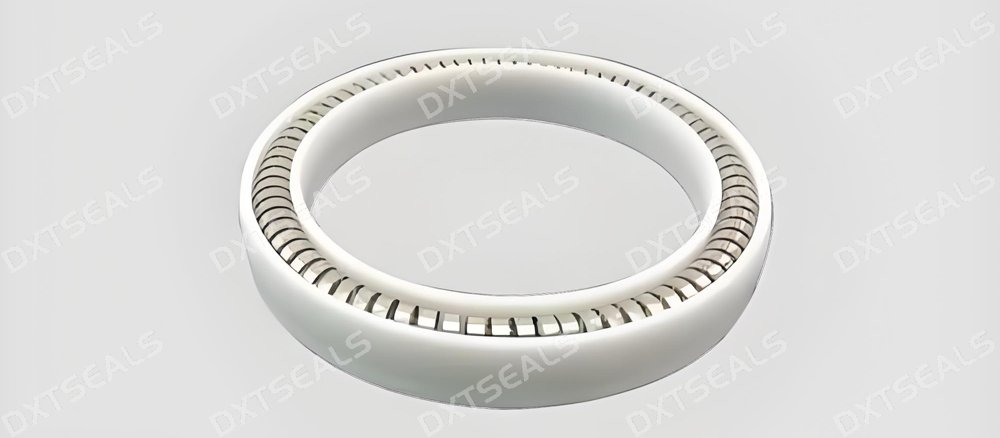
Rotary spring-energized seals consist of a PTFE or filled PTFE sealing jacket combined with an internal metal energizing spring. The spring provides constant sealing force, independent of system pressure, ensuring reliable sealing under dynamic conditions.
Overview of Conventional Rotary Seals
Conventional rotary seals typically use elastomer materials (such as NBR or FKM) with a flexible sealing lip. Sealing force mainly depends on material elasticity and interference fit, often assisted by system pressure.
Performance Comparison
| Performance Aspect | Rotary Spring-Energized Seals | Conventional Rotary Seals |
|---|---|---|
| Friction | Very low, stable | Higher, increases with wear |
| Speed Capability | Excellent for high speed | Limited at high speed |
| Temperature Range | Very wide | Limited by elastomer |
| Chemical Resistance | Excellent (PTFE-based) | Limited |
| Wear Resistance | High with filled PTFE | Moderate |
| Low-Pressure Sealing | Excellent | Limited |
| Service Life | Long | Shorter in harsh conditions |
Key Advantages of Rotary Spring-Energized Seals
Low Friction and Heat Generation
PTFE materials significantly reduce friction, minimizing heat buildup at high rotational speeds.
Stable Sealing Force
The metal spring maintains consistent contact pressure, even as wear or thermal expansion occurs.
Superior Chemical and Temperature Resistance
PTFE sealing jackets perform reliably in environments where elastomer seals degrade or fail.
Extended Service Life
Reduced wear and stable sealing performance result in longer service intervals and lower maintenance costs.
At DXTSEALS, rotary spring-energized seals are engineered to meet the demands of high-performance rotary applications.
When Conventional Rotary Seals Are Still Suitable
Despite their limitations, conventional rotary seals remain a practical choice for:
-
Low to moderate speed applications
-
Standard temperature and pressure conditions
-
Cost-sensitive equipment designs
Proper evaluation of operating conditions is essential before selecting a sealing solution.
Typical Applications of Rotary Spring-Energized Seals
-
High-speed pumps and compressors
-
Electric motors and spindles
-
Aerospace and precision machinery
-
Chemical processing equipment
In these applications, performance reliability outweighs initial component cost.
Conclusion
Rotary spring-energized seals and conventional rotary seals differ significantly in performance capabilities. While conventional seals are suitable for standard applications, rotary spring-energized seals offer superior performance in high-speed, high-temperature, high-pressure, and chemically aggressive environments.
Understanding these differences helps engineers select the most reliable and cost-effective sealing solution for their specific application.