
Introduction
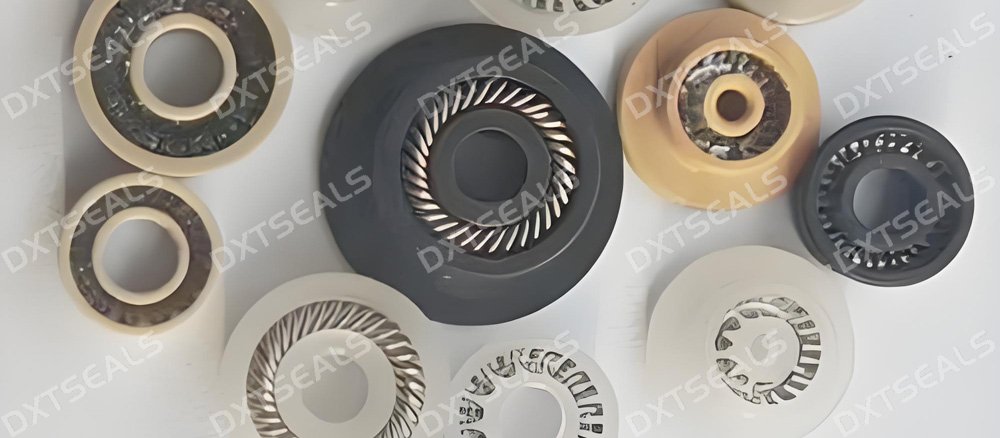
Spring energized seals are widely used in industries requiring high-performance sealing under extreme conditions. The sealing performance of these seals depends not only on the PTFE jacket material but also on the type of internal spring.
Different spring structures provide different levels of:
- Elastic force
- Pressure response
- Wear resistance
- Dynamic sealing capability
Among the most commonly used spring types are V-springs, helical springs, and U-springs. Understanding their differences is essential for selecting the right sealing solution.
At DXTSEALS, we provide customized spring energized seals optimized for various industrial applications.
1. Overview of Spring Functions in Spring Energized Seals
The internal spring in a spring energized seal serves several important functions:
- Provides initial sealing force
- Compensates for wear and material deformation
- Maintains sealing under pressure fluctuations
- Enhances sealing reliability in dynamic conditions
The spring design directly affects seal performance and application suitability.
2. V-Spring Seals
Structure Characteristics
V-springs use a cantilever-style spring with a continuous V-shaped structure.
Key Advantages
- Low friction performance
- Fast elastic response
- Excellent dynamic sealing capability
- Suitable for high-speed motion
Typical Applications
- Hydraulic and pneumatic systems
- Reciprocating motion equipment
- Aerospace sealing systems
Limitations
- Lower load capacity compared to helical springs
- May not be ideal for ultra-high pressure applications
V-springs are often preferred when low friction and dynamic performance are critical.
3. Helical Spring Seals
Structure Characteristics
Helical springs use a coil-shaped spring structure that provides uniform radial force.
Key Advantages
- High sealing force
- Excellent pressure resistance
- Strong compensation capability for wear and tolerance variation
- Suitable for vacuum and ultra-high pressure environments
Typical Applications
- Oil & gas equipment
- Vacuum systems
- Semiconductor industry
- High-pressure valves and pumps
Limitations
- Higher friction than V-springs
- Greater installation force may be required
Helical spring seals are ideal for applications requiring maximum sealing reliability and pressure resistance.
4. U-Spring Seals
Structure Characteristics
U-springs feature a U-shaped spring profile designed to provide balanced sealing force.
Key Advantages
- Moderate friction characteristics
- Good balance between flexibility and load capacity
- Stable sealing performance under varying conditions
Typical Applications
- General industrial equipment
- Medium-pressure systems
- Static and moderate dynamic sealing applications
Limitations
- Less responsive than V-springs in high-speed motion
- Lower sealing force compared to helical springs
U-springs are commonly used when a balanced and cost-effective solution is needed.
5. Performance Comparison
| Feature | V-Spring | Helical Spring | U-Spring |
|---|---|---|---|
| Friction Level | Low | Medium–High | Medium |
| Dynamic Performance | Excellent | Good | Moderate |
| Pressure Resistance | Medium | Very High | Medium–High |
| Wear Compensation | Good | Excellent | Good |
| Response Speed | Fast | Moderate | Moderate |
| Installation Force | Low | Higher | Medium |
| Typical Application | Dynamic sealing | High-pressure sealing | General industrial sealing |
6. How to Choose the Right Spring Type
Choose V-Spring When:
- Low friction is required
- High-speed dynamic sealing is involved
- Precision movement systems are used
Choose Helical Spring When:
- High pressure or vacuum conditions exist
- Maximum sealing reliability is needed
- Chemical or extreme environments are involved
Choose U-Spring When:
- Balanced performance is preferred
- Moderate pressure and speed conditions apply
- Cost efficiency is important
At DXTSEALS, we help customers select the most suitable spring structure based on actual operating conditions.
7. Additional Design Considerations
When selecting a spring type, engineers should also consider:
- PTFE material and filler selection
- Groove dimensions and tolerances
- Operating temperature range
- Chemical compatibility
- Static or dynamic application requirements
Proper coordination between spring design and seal material is essential for optimal performance.
Conclusion
The internal spring structure is one of the most important factors affecting the performance of spring energized seals.
- V-springs provide low friction and excellent dynamic sealing
- Helical springs offer superior pressure resistance and sealing force
- U-springs deliver balanced performance for general applications
Understanding these differences helps engineers choose the most suitable sealing solution for specific working conditions.
At DXTSEALS, we are committed to providing customized spring energized seals with optimized spring designs for reliable and long-lasting performance.
If you need assistance selecting the right spring energized seal or spring type, contact DXTSEALS today for professional support and tailored solutions.