
In modern industrial systems, sealing components are often required to operate under extremely demanding conditions. Applications involving cryogenic temperatures, ultra-high vacuum environments, and high-speed dynamic motion place strict requirements on sealing reliability, material stability, and wear resistance. Among various advanced sealing solutions, spring energized seals have become a preferred option due to their excellent adaptability and long service life.
As a professional sealing manufacturer, DXTSEALS provides customized spring energized sealing solutions for industries such as aerospace, semiconductor equipment, LNG systems, medical devices, and high-speed rotating machinery.
What Is a Spring Energized Seal?
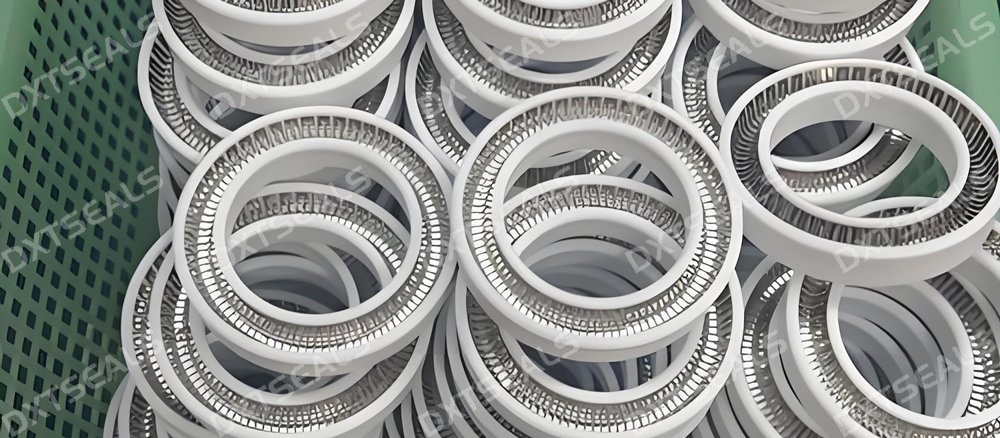
A spring energized seal is a high-performance sealing device consisting of a polymer jacket and an internal metal spring energizer. The spring continuously applies force to the sealing lip, ensuring stable sealing performance even when pressure fluctuations, temperature changes, or wear occur.
Compared with traditional O-rings or elastomer seals, spring energized seals offer:
- Wider temperature resistance
- Lower friction coefficient
- Superior chemical compatibility
- Excellent sealing performance under low pressure or vacuum
- Better dimensional stability
- Long operational lifespan
These advantages make them highly suitable for harsh operating environments.
Application Characteristics Under Low-Temperature Conditions
Cryogenic systems such as LNG equipment, liquid oxygen pipelines, and aerospace fuel systems often operate at temperatures below -100°C. Under such conditions, conventional rubber seals may harden, shrink, or crack, leading to sealing failure.
1. Excellent Low-Temperature Elasticity
Spring energized seals mainly use PTFE, modified PTFE, PEEK, or UHMWPE as jacket materials. These materials maintain relatively stable mechanical properties at extremely low temperatures.
The internal spring compensates for material shrinkage caused by thermal contraction, ensuring continuous sealing contact pressure.
2. Reduced Risk of Leakage
Low-temperature media usually have high permeability. The spring-loaded structure helps maintain sealing integrity even during rapid temperature transitions.
This is particularly important for:
- LNG valves
- Cryogenic pumps
- Aerospace fuel connectors
- Industrial gas transportation systems
3. Material Selection Is Critical
Different low-temperature applications require customized material combinations:
- Virgin PTFE for ultra-low friction
- Filled PTFE for wear resistance
- PEEK for higher mechanical strength
- Stainless steel springs for corrosion resistance
Proper groove design and thermal expansion calculations are also essential for stable sealing performance.
Performance Advantages in Vacuum Applications
Vacuum systems are widely used in semiconductor manufacturing, laboratory equipment, pharmaceutical processing, and aerospace technologies. In vacuum environments, sealing components must minimize gas permeation and outgassing.
1. Extremely Low Outgassing Performance
PTFE-based spring energized seals exhibit low volatile emissions, making them suitable for:
- High vacuum systems
- Ultra-high vacuum chambers
- Semiconductor processing equipment
- Analytical instruments
Low outgassing helps maintain vacuum stability and prevents contamination.
2. Reliable Sealing Under Low Pressure
Traditional elastomer seals often rely on system pressure to improve sealing force. However, vacuum systems provide little or no internal pressure assistance.
Spring energized seals solve this issue through mechanical spring loading, ensuring effective sealing even under zero-pressure conditions.
3. Chemical and Plasma Resistance
In semiconductor and chemical processing industries, vacuum equipment may be exposed to aggressive gases and plasma environments.
PTFE and advanced engineering plastics provide:
- Excellent chemical resistance
- Anti-corrosion capability
- Long-term dimensional stability
- Reduced particle generation
These characteristics significantly improve equipment reliability and maintenance intervals.
Advantages in High-Speed Dynamic Applications
High-speed rotary shafts and reciprocating systems generate significant frictional heat and wear. Common applications include:
- Turbomachinery
- Compressors
- Hydraulic servo systems
- High-speed spindles
- Automotive transmission systems
1. Low Friction Performance
PTFE-based sealing lips have an extremely low coefficient of friction, reducing:
- Heat generation
- Energy consumption
- Shaft wear
- Startup torque
This allows stable operation under high rotational speeds.
2. Excellent Wear Resistance
Filled PTFE compounds containing carbon fiber, graphite, bronze, or glass fiber can significantly enhance wear resistance.
Properly designed spring energized seals can maintain sealing effectiveness for extended service periods under continuous motion.
3. Stable Sealing Under Pressure Fluctuation
High-speed systems often experience rapid pressure changes and vibration. The spring energizer continuously compensates for lip wear and dimensional variation, maintaining reliable contact pressure.
This feature helps reduce leakage and prolong equipment maintenance cycles.
Key Design Considerations for Extreme Conditions
To ensure optimal performance in low-temperature, vacuum, and high-speed applications, several factors must be considered during seal design:
1. Jacket Material Selection
Material selection depends on:
- Temperature range
- Media compatibility
- Pressure conditions
- Friction requirements
- Wear resistance
2. Spring Type Optimization
Different spring designs provide different sealing characteristics:
- Cantilever springs for low friction
- Helical springs for higher load capacity
- Canted coil springs for balanced performance
3. Groove Design Accuracy
Improper groove dimensions may lead to:
- Excessive wear
- Seal deformation
- Leakage
- Installation failure
Precision machining and tolerance control are essential.
4. Surface Finish Requirements
High-speed and vacuum applications often require superior shaft and groove surface finishes to minimize leakage and friction.
Why Choose DXTSEALS?
DXTSEALS specializes in customized spring energized sealing solutions for extreme industrial environments. With extensive experience in material engineering and precision manufacturing, DXTSEALS provides:
- Custom seal design services
- PTFE and advanced polymer material solutions
- Technical support based on groove dimensions
- Low-temperature and vacuum sealing expertise
- High-speed dynamic sealing optimization
- Rapid prototype and production capabilities
Whether for cryogenic systems, semiconductor equipment, or high-speed rotating machinery, DXTSEALS can deliver reliable and cost-effective sealing solutions tailored to customer requirements.
Conclusion
Spring energized seals offer outstanding performance in low-temperature, vacuum, and high-speed applications where conventional seals often fail. Their unique spring-assisted structure, combined with high-performance polymer materials, enables reliable sealing under extreme operating conditions.
By selecting the proper materials, spring types, and groove designs, manufacturers can significantly improve sealing reliability, reduce maintenance costs, and extend equipment service life.
For customized sealing solutions and technical support, contact DXTSEALS to discuss your specific application requirements.