
In modern fluid power systems, hydraulic and pneumatic equipment demand reliable sealing solutions that can withstand high pressure, rapid motion, and a wide range of operating fluids.
Traditional rubber seals may fail under extreme temperatures, chemical exposure, or dynamic stress.
This is where PTFE spring-energized seals — a specialty of DXTSEALS — offer unmatched advantages in durability, stability, and precision.
1. What Are PTFE Spring-Energized Seals?
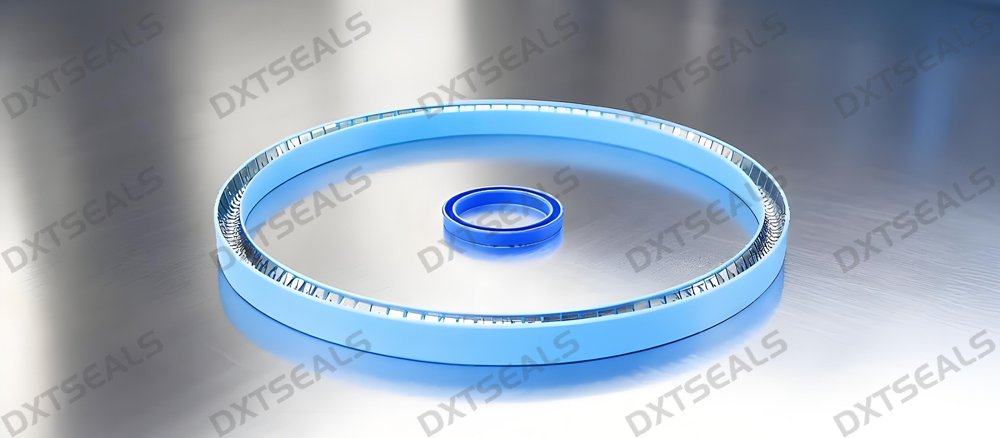
A PTFE spring-energized seal consists of a PTFE (polytetrafluoroethylene) jacket and a metal spring element inside.
The spring continuously applies radial force against the mating surface, ensuring reliable sealing even when system pressure fluctuates or surfaces expand thermally.
Key Features:
-
Low friction and excellent wear resistance
-
Wide temperature range (–70°C to +250°C)
-
Chemical inertness against most hydraulic fluids and gases
-
Self-compensating design for pressure variations
-
Minimal stick-slip and smooth motion
Thanks to these properties, PTFE seals outperform conventional elastomeric O-rings and U-cups in demanding hydraulic and pneumatic environments.
2. Advantages of PTFE Seals in Hydraulic Systems
Hydraulic systems operate under high pressure and temperature, where sealing failure can lead to serious leakage and efficiency loss.
Key Benefits in Hydraulic Applications:
-
Excellent Pressure Resistance:
PTFE seals maintain tight sealing up to 50 MPa (500 bar) depending on design, preventing fluid loss and contamination. -
Superior Wear Resistance:
Under continuous motion and metal-to-seal contact, PTFE offers low friction and minimal wear, extending service life. -
Temperature & Chemical Stability:
PTFE remains stable in contact with hydraulic oils, synthetic lubricants, and aggressive fluids, even under high heat. -
Smooth Dynamic Motion:
The low coefficient of friction ensures precise actuation and minimal hysteresis, essential for servo valves and precision actuators.
✅ DXTSEALS Recommendation:
For piston seals, rod seals, and rotary shaft seals in heavy-duty hydraulics, PTFE spring-energized seals offer superior leakage control and long-term stability compared with traditional NBR or PU seals.
3. Advantages of PTFE Seals in Pneumatic Systems
Pneumatic systems prioritize speed, cleanliness, and low friction over high pressure. PTFE seals meet these needs exceptionally well.
Key Benefits in Pneumatic Applications:
-
Low Friction for Smooth Motion:
PTFE prevents “stick-slip” behavior at low pressures, enabling accurate linear or rotary movement in actuators. -
No Lubrication Required:
Its self-lubricating surface ensures clean operation, ideal for food, medical, and semiconductor pneumatic devices. -
Excellent Gas Tightness:
The energized spring maintains consistent sealing even under vacuum or fluctuating air pressure, improving efficiency. -
Resistant to Moisture and Chemicals:
PTFE’s non-reactive nature prevents degradation when exposed to compressed air moisture, solvents, or cleaning agents.
✅ DXTSEALS Recommendation:
For air cylinders, control valves, and dynamic rods, PTFE spring-energized seals deliver maintenance-free, long-lasting sealing performance.
4. Types of Springs in PTFE Seals
The spring element determines how the seal behaves under load.
DXTSEALS offers several types for different hydraulic and pneumatic needs:
| Spring Type | Design | Application |
|---|---|---|
| Cantilever Spring | Linear deflection; high flexibility | Low-pressure pneumatics, light dynamic motion |
| Helical Coil Spring | Uniform load; stable sealing | Medium to high-pressure hydraulics |
| V-Spring (Canted Coil) | Constant force, self-adjusting | Extreme temperature, vacuum, or pressure cycling |
Each design is precision-engineered to maintain consistent contact force across the sealing surface — even as temperature or pressure changes.
5. Typical Applications in Industry
PTFE spring-energized seals are now essential in high-precision and safety-critical industries, including:
-
Hydraulic cylinders and pumps
-
Pneumatic actuators and valves
-
Aerospace hydraulic control systems
-
Medical and pharmaceutical pneumatic devices
-
Semiconductor processing equipment
-
Oil & gas instrumentation
Their versatility makes them a universal sealing solution across both fluid power and cleanroom applications.
6. Why Choose DXTSEALS for PTFE Sealing Solutions
At DXTSEALS, we specialize in custom-engineered PTFE spring-energized seals designed for specific operating pressures, fluids, and motion types.
We support customers with:
-
Advanced PTFE compounding (including carbon-filled, glass-filled, and bronze-filled options)
-
Precision CNC manufacturing for dimensional accuracy
-
Material compatibility testing for hydraulic fluids and gases
-
OEM/ODM customization and prototyping
Our mission is to provide sealing reliability and performance consistency across all your hydraulic and pneumatic applications.
Conclusion
The application value of PTFE spring-energized seals in hydraulic and pneumatic systems lies in their exceptional chemical resistance, wear durability, and temperature tolerance.
They ensure leak-free performance, smooth motion, and extended service life, outperforming traditional rubber seals in critical environments.
Whether you’re optimizing a high-pressure hydraulic actuator or designing a precision pneumatic valve, DXTSEALS can deliver a tailored PTFE sealing solution that meets your toughest engineering challenges.
DXTSEALS — Precision Sealing Solutions for Hydraulic and Pneumatic Systems.
Visit www.dxtseals.com to explore our full range of PTFE seals and custom-engineered components.