
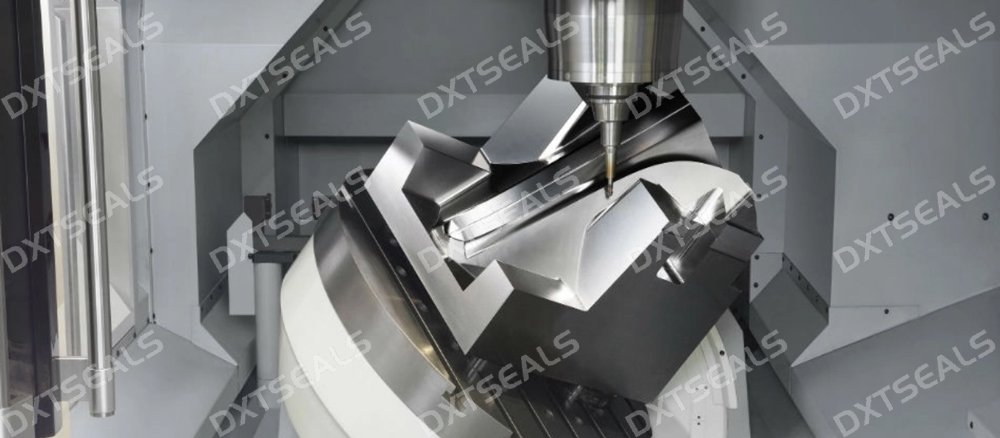
5-axis CNC machining is an advanced manufacturing process that allows cutting tools and workpieces to move along multiple controlled axes. Compared with conventional 3-axis machining, 5-axis CNC machining provides greater flexibility in tool orientation and can access multiple surfaces of a component with fewer setups.
This capability makes 5-axis machining particularly useful for complex components, precision parts, angled surfaces, curved geometries, and applications where maintaining accurate positional relationships between multiple features is important.
From aerospace and medical components to industrial machinery, molds, energy equipment, and custom sealing components, 5-axis CNC machining can provide an efficient solution for manufacturing geometrically complex parts.
What Is 5-Axis CNC Machining?
A conventional 3-axis CNC machining center typically controls movement along three linear axes:
-
X-axis
-
Y-axis
-
Z-axis
A 5-axis CNC machine adds two rotational axes to the three linear axes. Depending on the machine configuration, these rotational axes may be designated as A, B, or C.
The additional rotational movement allows the cutting tool or workpiece to be positioned from different directions.
In practical terms, 5-axis machining can allow a cutting tool to approach a component at an optimized angle instead of being limited to a fixed vertical or horizontal orientation.
There are two general approaches:
-
3+2 machining: The rotary axes position the workpiece or tool, after which conventional 3-axis cutting is performed.
-
Simultaneous 5-axis machining: Multiple axes move together during cutting, allowing continuous changes in tool orientation.
The appropriate method depends on the component geometry, tolerance requirements, tooling, and manufacturing strategy.
Key Features of 5-Axis CNC Machining
Multi-Directional Tool Movement
The most important feature of 5-axis machining is its ability to control tool orientation from multiple directions.
This makes it possible to machine surfaces that would otherwise require repositioning the workpiece.
Reduced Number of Setups
Complex components often require multiple setups on conventional machines.
Each additional setup can introduce potential variation in:
-
Workpiece positioning
-
Datum alignment
-
Fixture location
-
Feature-to-feature accuracy
5-axis machining can reduce the number of setups required for many complex components.
Improved Tool Orientation
The cutting tool can be positioned more favorably relative to the machined surface.
This can help improve:
-
Cutting conditions
-
Surface finish
-
Tool access
-
Tool life
-
Machining efficiency
The actual improvement depends on the material, tool, geometry, and cutting strategy.
Complex Surface Machining
5-axis CNC machines are particularly suitable for components with:
-
Curved surfaces
-
Compound contours
-
Angled faces
-
Deep features
-
Multiple intersecting surfaces
-
Complex 3D geometries
5-Axis CNC Machining vs 3-Axis Machining
The primary difference is the number of controlled axes and the resulting flexibility in tool orientation.
| Feature | 3-Axis CNC Machining | 5-Axis CNC Machining |
|---|---|---|
| Linear axes | X, Y, Z | X, Y, Z |
| Rotary axes | None | Two additional rotary axes |
| Tool orientation | More limited | Highly flexible |
| Complex angled surfaces | May require multiple setups | Often easier to access |
| Multiple setups | More common for complex parts | Can often be reduced |
| 3D surface machining | Capable | More flexible |
| Programming | Generally simpler | More complex |
| Machine investment | Generally lower | Generally higher |
| Ideal applications | Standard components | Complex precision components |
A 5-axis machine is not automatically the better choice for every component. Simple plates, brackets, blocks, and many rotational parts can often be manufactured more economically using conventional CNC milling or turning.
Advantages of 5-Axis CNC Machining
1. Fewer Workpiece Setups
One of the most important advantages of 5-axis machining is the ability to access multiple surfaces without manually repositioning the workpiece as frequently.
Fewer setups can help reduce:
-
Setup time
-
Handling time
-
Alignment operations
-
Re-fixturing errors
-
Production interruptions
This can be particularly beneficial for complex components.
2. Improved Feature-to-Feature Accuracy
When several features are machined in a single setup, their positional relationship can be maintained more consistently.
This is important for components where multiple surfaces, holes, and angled features must remain accurately aligned.
However, final accuracy still depends on machine condition, thermal stability, fixturing, tooling, programming, and inspection.
3. Better Access to Complex Geometry
Five-axis movement allows cutting tools to approach surfaces that may be difficult or impossible to reach using a fixed-axis setup.
This is particularly useful for:
-
Angled surfaces
-
Undercut-related geometries
-
Deep cavities
-
Complex contours
-
Compound surfaces
4. Improved Tool Orientation
Tool orientation can be optimized during machining.
Maintaining an appropriate tool angle can help reduce unfavorable cutting conditions and may improve surface finish and tool performance.
This is especially useful when machining complex three-dimensional surfaces.
5. Reduced Need for Special Fixtures
For some components, conventional machining may require specially designed fixtures to expose different surfaces.
5-axis machining can reduce the need for some of these fixtures by providing additional machining access.
This can be particularly valuable for low-volume custom parts and complex prototypes.
6. Efficient Complex-Part Production
Although 5-axis machines typically involve higher equipment and programming costs, they can become highly efficient when machining complex components that would otherwise require many separate operations.
The economic advantage depends on:
-
Part geometry
-
Production quantity
-
Number of setups
-
Programming requirements
-
Material
-
Tolerance
-
Required surface finish
3+2 Machining vs Simultaneous 5-Axis Machining
Not every 5-axis operation requires continuous movement of all five axes.
3+2 Machining
In 3+2 machining, the rotary axes position the workpiece or cutting tool at a selected angle.
The actual cutting operation then takes place using three linear axes.
This approach is often suitable for:
-
Angled holes
-
Inclined surfaces
-
Multiple planar faces
-
Complex parts that do not require continuous tool orientation
3+2 machining can provide many of the setup-reduction advantages of 5-axis equipment while keeping the cutting strategy relatively straightforward.
Simultaneous 5-Axis Machining
In simultaneous 5-axis machining, multiple axes can move continuously during cutting.
This enables the tool orientation to change dynamically as the tool follows a complex surface.
It is particularly useful for:
-
Complex freeform surfaces
-
Turbine components
-
Impellers
-
Aerospace components
-
Advanced molds
-
Complex medical components
Simultaneous machining generally requires more sophisticated CAM programming, machine control, and process planning.
Materials Suitable for 5-Axis CNC Machining
5-axis CNC machining can be used with many machinable materials.
Metals
Common materials include:
-
Aluminum
-
Stainless steel
-
Carbon steel
-
Tool steel
-
Titanium alloys
-
Copper
-
Brass
-
Nickel-based alloys
The cutting tools, speeds, feeds, coolant strategy, and workholding must be adapted to the specific material.
Engineering Plastics
5-axis machining can also be used for:
-
PTFE
-
PEEK
-
Nylon
-
UHMW-PE
-
Acetal
-
Other engineering plastics
Plastic machining requires special attention to heat generation, deformation, tool geometry, and workholding.
Graphite and Carbon-Based Materials
Graphite and carbon graphite components can also be CNC machined into complex geometries.
Because graphite can be brittle and abrasive, machining strategies and dust management should be appropriately designed.
Industrial Applications of 5-Axis CNC Machining
Aerospace Components
Aerospace manufacturing is one of the most well-known applications of 5-axis machining.
Aircraft and aerospace components often contain complex curved surfaces and tight dimensional relationships.
Applications may include:
-
Structural components
-
Engine components
-
Turbine-related parts
-
Complex housings
-
Lightweight components
Automotive Manufacturing
5-axis machining can be used for:
-
Prototype components
-
Engine-related components
-
Transmission parts
-
Complex molds
-
Specialized fixtures
-
Performance components
It is particularly useful when a component contains multiple angled or curved surfaces.
Medical Components
Medical manufacturing often requires small, precise components with complex geometries.
Potential applications include:
-
Surgical instruments
-
Orthopedic components
-
Medical housings
-
Precision fixtures
-
Implant-related manufacturing
Material and regulatory requirements must be considered separately for components intended for medical use.
Mold and Tool Manufacturing
Mold components often contain complex 3D surfaces that benefit from flexible tool orientation.
5-axis machining can help reduce the number of setups required for:
-
Injection molds
-
Die components
-
Forming tools
-
Complex cavities
-
Precision inserts
Energy Industry
5-axis machining can be used for components in:
-
Power-generation equipment
-
Turbomachinery
-
Energy systems
-
Industrial pumps
-
Specialized valves
-
Complex rotating equipment
Industrial Machinery
Many industrial machines contain custom components that are not economically available as standard parts.
5-axis machining can manufacture:
-
Complex brackets
-
Machine housings
-
Precision fixtures
-
Custom mechanical components
-
Specialized tooling
-
Equipment parts
5-Axis CNC Machining for Sealing Components
Although many sealing components are rotational and can be efficiently manufactured using CNC turning, some sealing-related parts require milling and multi-axis machining.
Examples include:
-
Complex seal housings
-
Custom sealing plates
-
Valve sealing components
-
Mechanical seal components
-
Special PTFE components
-
Graphite components
-
Complex sealing rings
-
Custom equipment parts
For example, a simple cylindrical PTFE seal may be efficiently produced using CNC turning. However, if the component includes multiple angled surfaces, pockets, mounting holes, or complex profiles, 5-axis milling may provide greater manufacturing flexibility.
This combination of CNC turning, milling, and 5-axis machining allows manufacturers to select the appropriate process for each component rather than using a single machining method for every application.
5-Axis Machining of PTFE and Engineering Plastics
Engineering plastics often require careful machining because they can behave differently from metals.
PTFE, for example, has a relatively low stiffness and can deform under excessive clamping force or cutting pressure.
When machining complex PTFE components, manufacturers may need to consider:
-
Workholding pressure
-
Tool geometry
-
Cutting forces
-
Heat generation
-
Material deformation
-
Dimensional stability
-
Post-machining dimensional changes
5-axis machining can provide flexible tool access, but the machining strategy still needs to account for the physical properties of the material.
5-Axis Machining of Graphite Components
Graphite is another material where specialized CNC machining practices are important.
Graphite can be brittle and abrasive, so appropriate:
-
Cutting tools
-
Cutting parameters
-
Workholding
-
Dust extraction
-
Machining strategies
are important for achieving consistent results.
5-axis machining can be useful for graphite components with complex geometries, particularly when multiple surfaces or angled features must be machined accurately.
Factors to Consider When Choosing 5-Axis CNC Machining
5-axis machining offers significant capabilities, but it should be selected based on actual manufacturing requirements.
Part Geometry
The first consideration is whether the component actually requires multi-directional machining.
Simple geometries may not justify 5-axis processing.
Tolerance Requirements
Tight tolerances may benefit from fewer setups, but the entire machining and inspection process must be considered.
Surface Finish
Complex curved surfaces may require continuous tool orientation to achieve the desired surface finish.
Material
Different materials require different tooling and machining parameters.
Production Volume
For low-volume complex components, reducing setups may provide significant benefits. For high-volume simple components, conventional machining may be more economical.
Programming Requirements
5-axis machining requires more advanced CAM programming and process planning than basic 3-axis machining.
Machine Configuration
Not all 5-axis machines have the same working envelope, spindle capability, rotary-axis configuration, or accuracy.
Machine selection should therefore be based on the actual component requirements.
Inspection and Quality Control
Precision machining does not end when the cutting operation is completed.
Depending on the application, inspection may include:
-
Dimensional inspection
-
Diameter measurement
-
Profile inspection
-
Surface finish measurement
-
Position and orientation verification
-
Geometric tolerance inspection
-
Material verification
For complex 5-axis components, coordinate measuring machines and other advanced inspection equipment may be used where appropriate.
The combination of controlled machining and inspection helps ensure that complex features remain within the specified requirements.
Choosing a 5-Axis CNC Machining Manufacturer
When selecting a supplier for 5-axis CNC machining, it is useful to evaluate more than the machine's nominal axis count.
Important capabilities may include:
-
5-axis machining centers
-
Advanced CAM programming
-
CNC milling
-
CNC turning
-
Mill-turn machining
-
Precision tooling
-
Custom workholding
-
Material-specific machining experience
-
Dimensional inspection
-
Prototype production
-
Small-batch manufacturing
-
OEM production
A manufacturer with multiple machining capabilities can choose the most efficient process based on the actual component geometry.
Conclusion
5-axis CNC machining provides advanced flexibility for manufacturing complex precision components. By combining three linear axes with two rotational axes, 5-axis machines can provide greater tool access, improved tool orientation, and fewer setups for many complex parts.
The technology is particularly valuable for components with curved surfaces, angled features, multiple machined faces, and complex three-dimensional geometries. Applications include aerospace, automotive, medical, mold manufacturing, energy equipment, industrial machinery, and specialized sealing components.
However, 5-axis machining is not automatically the best solution for every part. CNC turning, 3-axis milling, 3+2 machining, and mill-turn machining can be more efficient for simpler components.
The most effective CNC manufacturing strategy is to match the machine configuration to the part geometry, material, tolerance, surface finish, production volume, and overall application requirements.