
Introduction
The aerospace and automotive industries require high-performance metal components that meet strict standards for strength, precision, durability, and reliability. Selecting the right materials and machining processes is essential to achieving optimal performance in demanding operating environments.
This article analyzes the most commonly used metal materials in aerospace and automotive manufacturing and explores the machining techniques used to produce precision components.
Key Requirements in Aerospace and Automotive Manufacturing
Both industries share several important manufacturing requirements:
-
High structural strength
-
Lightweight design
-
Excellent fatigue resistance
-
Corrosion resistance
-
High dimensional accuracy
To meet these demands, manufacturers rely on advanced metal materials combined with precision machining technologies.
Common Metal Materials Used in Aerospace and Automotive Applications
Aluminum Alloys
Aluminum alloys are widely used due to their lightweight properties and excellent machinability.
Advantages:
-
Low density and high strength-to-weight ratio
-
Good thermal conductivity
-
Excellent corrosion resistance after surface treatment
Typical Applications:
-
Aircraft structural components
-
Automotive engine parts
-
Transmission housings
-
Lightweight frames
Titanium Alloys
Titanium alloys are commonly used in aerospace and high-performance automotive applications.
Advantages:
-
Exceptional strength-to-weight ratio
-
Excellent corrosion resistance
-
High temperature resistance
Typical Applications:
-
Aircraft engine components
-
Aerospace structural parts
-
High-performance automotive systems
However, titanium alloys require specialized machining strategies due to their low thermal conductivity and high cutting resistance.
Stainless Steel
Stainless steel provides excellent corrosion resistance and mechanical strength.
Advantages:
-
High durability
-
Good heat resistance
-
Strong structural integrity
Typical Applications:
-
Exhaust systems
-
Fasteners and structural components
-
Aerospace hardware
Alloy Steel
Alloy steels are widely used for components requiring high strength and wear resistance.
Advantages:
-
High load-bearing capacity
-
Excellent fatigue resistance
-
Good performance after heat treatment
Typical Applications:
-
Gears
-
Shafts
-
Transmission components
At DXTSEALS, advanced machining techniques are applied to process high-strength materials used in demanding industrial environments.
Machining Processes Used in Aerospace and Automotive Components
CNC Turning
CNC turning is commonly used for rotational parts such as shafts, pins, and cylindrical components.
CNC Milling
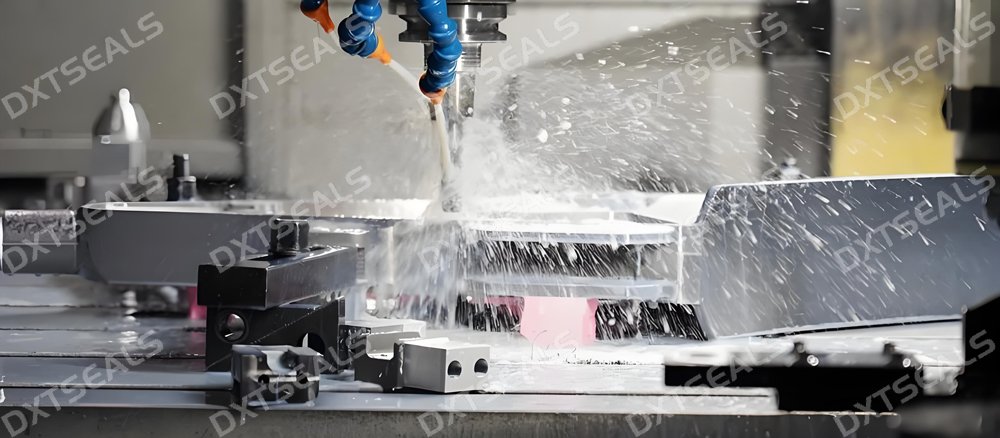
CNC milling enables the machining of complex geometries, structural frames, and precision surfaces.
Multi-Axis CNC Machining
Multi-axis machining allows complex components to be produced with fewer setups, improving both accuracy and efficiency.
Precision Grinding
Grinding is often used for finishing hardened components requiring extremely tight tolerances.
Surface Treatments for Performance Enhancement
To improve durability and performance, machined components often undergo surface treatments such as:
-
Anodizing for aluminum components
-
Heat treatment for alloy steels
-
Passivation for stainless steel
-
Coating processes for improved wear resistance
These treatments enhance corrosion resistance, hardness, and overall service life.
Quality Control in High-Precision Manufacturing
Aerospace and automotive components require strict quality assurance, including:
-
Coordinate Measuring Machine (CMM) inspection
-
Surface roughness measurement
-
Material property testing
-
Dimensional verification
Maintaining strict quality standards ensures reliability in critical systems.
Future Trends in Metal Machining for Aerospace and Automotive Industries
Advancements in manufacturing technologies are driving innovation, including:
-
High-speed CNC machining
-
5-axis machining for complex structures
-
Lightweight material development
-
Smart manufacturing and automation
These technologies help improve production efficiency while maintaining high precision.
Conclusion
The aerospace and automotive industries rely heavily on advanced metal materials and precision machining technologies to produce high-performance components. Materials such as aluminum alloys, titanium alloys, stainless steel, and alloy steels each offer unique advantages depending on application requirements.
By combining the right material selection with optimized machining processes and strict quality control, manufacturers can deliver reliable components that meet the demanding standards of modern aerospace and automotive engineering.