
Introduction
In high-performance sealing systems, static sealing applications often require zero leakage, long service life, and resistance to extreme conditions. Bore-type spring-energized seals, also known as internal spring-energized seals, are widely used in static sealing scenarios where conventional elastomer seals are insufficient.
This article explains the key features of bore-type spring-energized seals and highlights their advantages in static sealing applications.
What Is a Bore-Type Spring-Energized Seal?
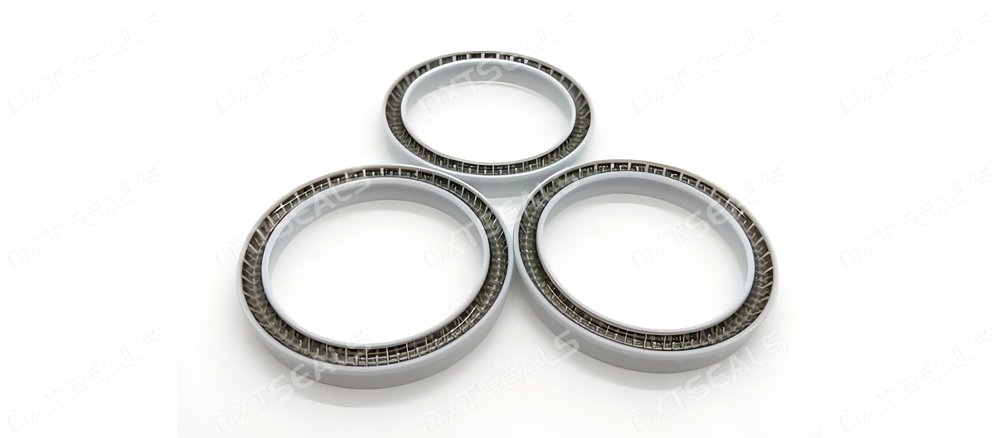
A bore-type spring-energized seal is installed in a housing groove and seals against a stationary or non-moving shaft or plug. The seal typically consists of:
-
A PTFE or filled PTFE sealing jacket
-
An internal energizing spring that provides constant sealing force
This structure allows the seal to maintain reliable contact pressure regardless of pressure fluctuations or dimensional tolerances.
Key Features of Bore-Type Spring-Energized Seals
Reliable Sealing at Low or Zero Pressure
Unlike elastomer O-rings that rely heavily on system pressure, bore-type spring-energized seals provide initial sealing force through the spring, ensuring effective sealing even in low-pressure or vacuum conditions.
Excellent Chemical and Temperature Resistance
PTFE-based materials offer outstanding resistance to aggressive media and a wide operating temperature range, making these seals suitable for demanding industrial environments.
Compensation for Tolerances and Wear
The energizing spring continuously compensates for machining tolerances, thermal expansion, and material wear, ensuring consistent sealing performance over time.
Low Compression Set and Long Service Life
Compared to rubber seals, spring-energized seals exhibit minimal compression set, resulting in extended service life in static applications.
Advantages in Static Sealing Applications
Zero-Leakage Performance
Bore-type spring-energized seals are ideal for applications where leakage is unacceptable, such as high-purity fluid systems and pressure containment components.
High Pressure Capability
The seal structure allows system pressure to enhance sealing performance, enabling reliable operation under high static pressure conditions.
Reduced Maintenance Requirements
Thanks to their durability and resistance to degradation, these seals help reduce maintenance frequency and downtime.
Typical Static Sealing Applications
-
Valve bodies and valve seats
-
Hydraulic and pneumatic manifolds
-
Pressure vessels and housings
-
Chemical processing equipment
-
Oil and gas static sealing components
At DXTSEALS, we provide bore-type spring-energized seals designed to meet strict static sealing requirements across various industries.
Conclusion
Bore-type spring-energized seals combine advanced PTFE materials with precision spring energization to deliver reliable, long-lasting static sealing performance. Their ability to seal at low pressure, resist harsh media, and maintain consistent contact force makes them an excellent choice for critical static sealing applications.
Selecting the right bore-type spring-energized seal is key to achieving leak-free and stable system performance.