
Introduction
CNC machining is a core manufacturing technology used to produce high-precision metal and plastic components. Among the most common CNC processes are CNC turning and CNC milling. Although both rely on computer-controlled machines, their machining principles, capabilities, and application scenarios differ significantly.
This article explains the key differences between CNC turning and CNC milling and helps manufacturers choose the most suitable process for specific machining requirements.
What Is CNC Turning?
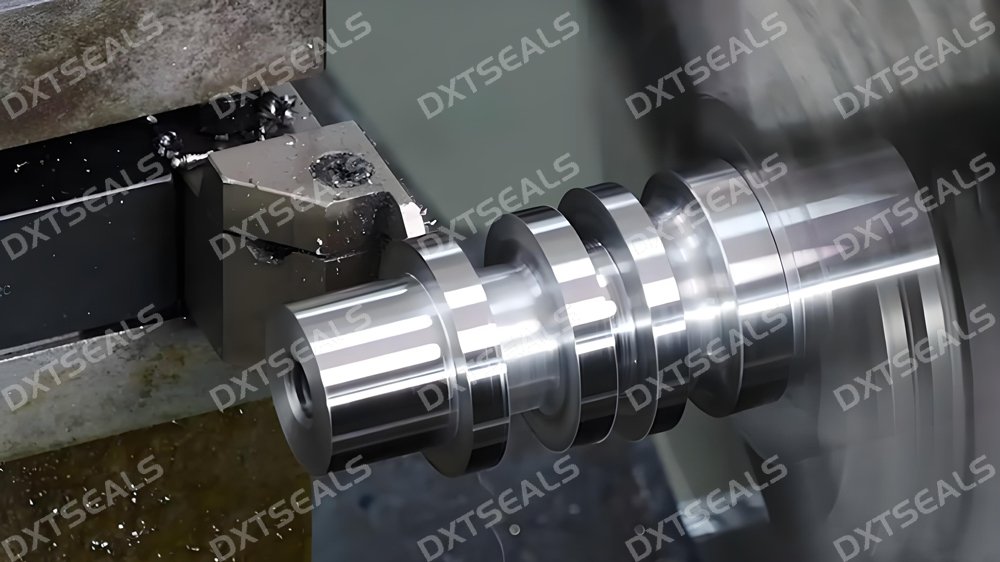
CNC turning is a machining process in which the workpiece rotates while a stationary cutting tool removes material. It is typically performed on a CNC lathe and is ideal for producing rotationally symmetrical parts.
Key Characteristics of CNC Turning
-
High efficiency for cylindrical and round components
-
Excellent dimensional accuracy and concentricity
-
Smooth surface finishes on external and internal diameters
-
Cost-effective for high-volume production
At DXTSEALS, CNC turning is widely used to manufacture precision shafts, bushings, seal housings, and rotational components.
Typical CNC Turning Applications
-
Shafts and pins
-
Bushings and sleeves
-
Flanges and rings
-
Threaded components
What Is CNC Milling?
CNC milling is a machining process in which the cutting tool rotates while the workpiece remains fixed or moves along multiple axes. CNC milling machines can produce complex shapes and multi-surface features.
Key Characteristics of CNC Milling
-
Capable of machining complex geometries
-
Suitable for flat surfaces, slots, pockets, and contours
-
Multi-axis machining for high-precision components
-
High flexibility for low-volume and custom parts
Typical CNC Milling Applications
-
Structural components
-
Brackets and housings
-
Complex cavities and profiles
-
Precision plates and frames
CNC Turning vs CNC Milling: Key Differences
| Aspect | CNC Turning | CNC Milling |
|---|---|---|
| Workpiece Movement | Rotates | Fixed or multi-axis movement |
| Tool Movement | Linear | Rotational |
| Ideal Shapes | Cylindrical, round | Flat, complex, irregular |
| Production Efficiency | High for round parts | High flexibility |
| Typical Machines | CNC Lathe | CNC Milling Machine |
How to Choose the Right Machining Process
Choose CNC Turning When:
-
The part is rotationally symmetrical
-
High concentricity is required
-
Large production volumes are needed
Choose CNC Milling When:
-
The part has complex geometries
-
Multiple surfaces require machining
-
Tight tolerances on flat or contoured surfaces are critical
In many cases, combined turning and milling processes are used to achieve optimal results.
CNC Turning and Milling in Precision Manufacturing
Modern manufacturing often integrates both processes to produce high-precision components efficiently. For sealing systems and industrial hardware, combining CNC turning and milling ensures accuracy, reliability, and consistency.
At DXTSEALS, both CNC turning and CNC milling are applied based on part geometry, material selection, and performance requirements.
Conclusion
CNC turning and CNC milling each offer distinct advantages and are suitable for different machining scenarios. CNC turning excels in efficiency for cylindrical parts, while CNC milling provides unmatched flexibility for complex geometries.
Understanding their differences allows manufacturers to select the most effective machining process, improving product quality, cost control, and production efficiency.