
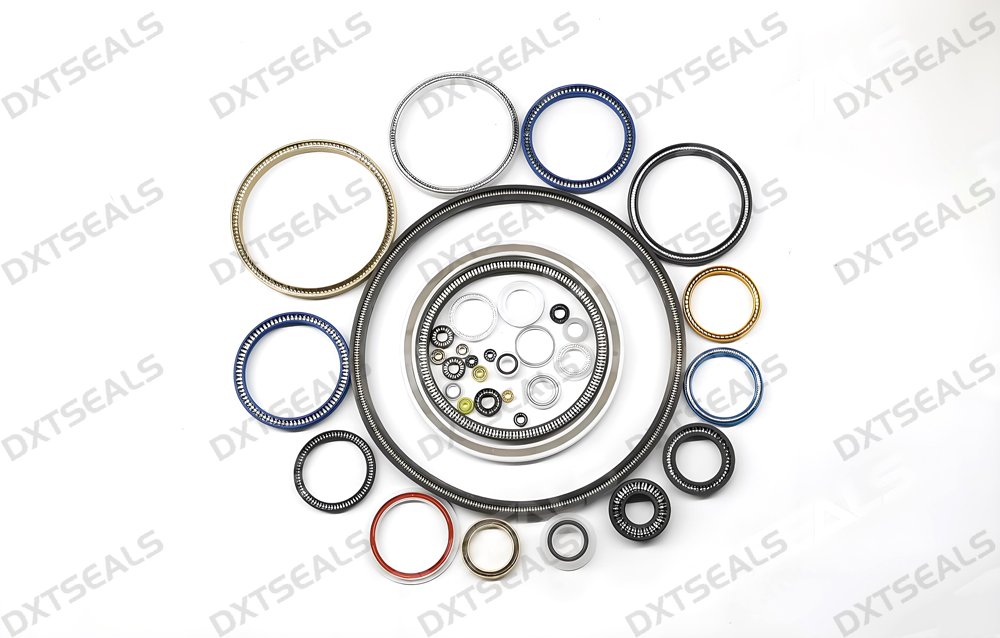
Sealing components are critical in ensuring leak-free performance, durability, and reliability across various industries. Among the most widely used custom parts are rubber gaskets, O-rings, and PTFE spring seals (also known as variseals or spring-energized seals). Each of these components serves a specific purpose and offers unique advantages depending on the application.
In this article, we will compare these three common sealing solutions to help you choose the most suitable option for your equipment and working conditions.
1. Rubber Gaskets: Simple and Versatile
Features:
-
Made from elastomers such as NBR, EPDM, FKM, or silicone.
-
Designed in flat shapes to cover flanges or sealing surfaces.
-
Flexible and compressible to fill irregular gaps.
Advantages:
-
Cost-effective and easy to produce in custom sizes.
-
Excellent for sealing low to medium pressure systems.
-
Resistant to water, oils, and moderate chemicals.
Applications:
-
Pipe flange connections.
-
Automotive and machinery sealing interfaces.
-
General industrial equipment.
Rubber gaskets are the go-to choice when cost efficiency and broad chemical compatibility are required.
2. O-Rings: Compact and Widely Used
Features:
-
Circular cross-section with high elasticity.
-
Available in a wide range of elastomers (NBR, EPDM, FKM, HNBR, silicone, etc.).
-
Designed to work under compression in static or dynamic sealing.
Advantages:
-
Compact size and easy installation.
-
Versatile for both radial and axial sealing.
-
Cost-efficient with standardized dimensions.
Applications:
-
Hydraulic and pneumatic cylinders.
-
Automotive engines and transmissions.
-
Valves, pumps, and fittings.
O-rings are ideal for medium pressure and temperature conditions, offering reliable performance in millions of applications worldwide.
3. PTFE Spring Seals (Variseals): High-Performance Sealing
Features:
-
Made of PTFE or modified PTFE, energized by a stainless-steel spring.
-
Designed for extreme environments with high temperature, pressure, and chemical exposure.
-
Excellent low-friction and wear-resistant properties.
Advantages:
-
Superior chemical resistance compared to elastomers.
-
Suitable for cryogenic to ultra-high-temperature applications.
-
Long service life in dynamic sealing environments.
Applications:
-
Aerospace and aviation.
-
Chemical processing equipment.
-
High-pressure hydraulic and oil & gas systems.
PTFE spring seals are the premium choice when extreme reliability and performance are needed under harsh conditions.
Comparison Table
| Sealing Part | Material | Pressure Range | Temperature Resistance | Key Applications |
|---|---|---|---|---|
| Rubber Gasket | NBR, EPDM, FKM, Silicone | Low to Medium | -40°C to +200°C | Flange sealing, machinery |
| O-Ring | NBR, EPDM, FKM, HNBR, Silicone | Medium | -40°C to +250°C | Hydraulics, pneumatics, automotive |
| PTFE Spring Seal | PTFE + Spring | High to Ultra-High | -200°C to +300°C | Aerospace, chemical, oil & gas |
Conclusion
Each sealing solution has its unique role in industrial applications:
-
Rubber gaskets are cost-efficient and versatile.
-
O-rings are compact and widely applicable.
-
PTFE spring seals are high-performance solutions for extreme environments.
📌 At DXTSEALS, we specialize in providing custom sealing solutions tailored to your application requirements. Whether you need standard O-rings, precision-engineered gaskets, or high-performance PTFE spring seals, we can deliver reliable products that ensure long-lasting sealing performance.