
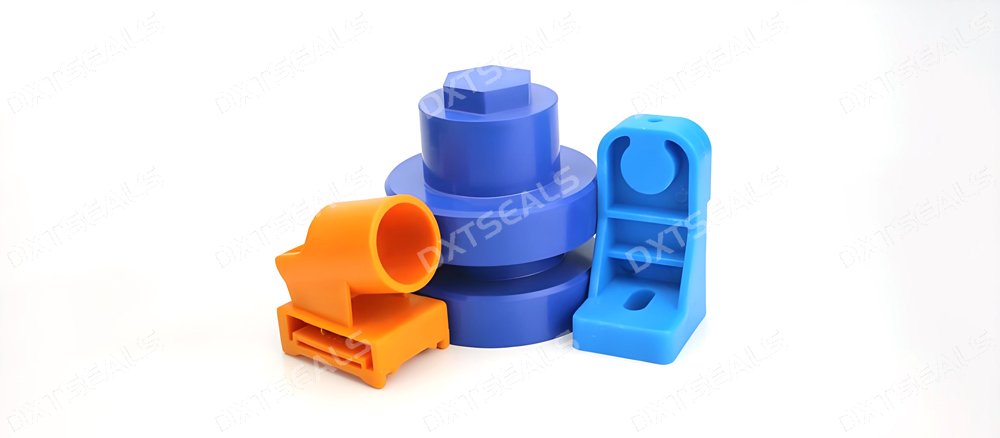
In the field of industrial sealing and component production, custom rubber and plastic parts play a crucial role in achieving reliable performance under demanding conditions. However, during the design, tooling, and molding processes, engineers often face various defects and performance issues that affect product quality and service life.
As a professional sealing manufacturer, DXTSEALS summarizes the most common problems in custom rubber and plastic part production, along with practical solutions to help engineers ensure stable and durable products.
1. Dimensional Inaccuracy and Tolerance Issues
Problem:
One of the most frequent issues in custom molding is size deviation. Rubber and plastic materials have different shrinkage rates during cooling or vulcanization, leading to dimensional variation between parts.
Causes:
-
Mold design not compensating for shrinkage
-
Inconsistent curing or cooling time
-
Material batch differences
Solutions:
-
Adjust mold cavity dimensions according to verified shrinkage data
-
Maintain consistent temperature and curing time during production
-
Use high-precision CNC molds and regularly calibrate measuring tools
-
For high-tolerance parts, apply secondary machining or post-finishing
DXTSEALS uses precision compression and injection molding combined with tight QC inspection to ensure every part meets drawing requirements.
2. Surface Defects: Bubbles, Flash, and Roughness
Problem:
Common surface defects such as air bubbles, flash edges, or rough textures not only affect appearance but also compromise sealing performance.
Causes:
-
Trapped air in the mold cavity
-
Improper mold venting or temperature control
-
Excessive injection pressure or incomplete curing
Solutions:
-
Optimize mold venting channels and injection gate design
-
Control temperature and pressure profiles during molding
-
Use vacuum-assisted molding for complex shapes
-
Implement deflash and surface treatment processes for finished parts
DXTSEALS employs automated trimming and polishing equipment to ensure clean edges and smooth gasket surfaces.
3. Material Incompatibility with Operating Media
Problem:
If the selected rubber or plastic material is not compatible with the operating medium (oil, chemical, water, gas, etc.), it may result in swelling, softening, or cracking.
Solutions:
-
Choose materials based on chemical compatibility charts
-
For oil and fuel systems, use NBR or FKM
-
For water and outdoor exposure, use EPDM or Silicone
-
For chemical and high-temperature environments, PTFE, PEEK, or FKM perform best
At DXTSEALS, we assist customers in material selection according to the medium, temperature, and pressure conditions, preventing premature gasket failure.
4. Deformation and Compression Set Problems
Problem:
After long-term use under compression, rubber parts may lose elasticity, leading to seal leakage or shape distortion.
Causes:
-
Inadequate material hardness
-
Over-compression during installation
-
Prolonged exposure to high temperature
Solutions:
-
Select materials with low compression set (e.g., FKM, Silicone, HNBR)
-
Use correct groove and installation dimensions
-
Avoid continuous overloading at high temperatures
-
Conduct compression set testing during design verification
DXTSEALS designs sealing components optimized for durability and resilience, ensuring long-term performance even under high-pressure or high-heat conditions.
5. Bonding and Adhesion Failure
Problem:
For parts combining rubber with metal or plastic inserts, poor bonding can cause delamination or leakage.
Solutions:
-
Apply specialized adhesive primers for rubber-metal bonding
-
Ensure surface cleanliness and roughness before molding
-
Use controlled curing cycles to improve adhesion strength
-
Perform peel or tensile tests to verify bonding reliability
DXTSEALS provides integrated rubber-to-metal bonding solutions for dynamic and static sealing applications.
6. Warping and Deformation in Plastic Parts
Problem:
Plastic components such as PEEK, POM, or nylon may warp due to uneven cooling or internal stress.
Causes:
-
Uneven mold temperature
-
Improper gate placement or cooling channel design
-
High shrinkage rate of the material
Solutions:
-
Use balanced cooling systems in molds
-
Optimize part geometry to reduce stress points
-
Perform annealing after molding for dimensional stability
At DXTSEALS, precision molding of high-performance plastics ensures consistent flatness, dimensional accuracy, and mechanical strength.
7. Improper Design for Assembly or Function
Problem:
Even if molded perfectly, parts may not fit correctly if the design tolerances, groove sizes, or assembly interfaces are inaccurate.
Solutions:
-
Conduct 3D modeling and interference analysis before tooling
-
Follow ISO or ASTM design standards for O-rings and gaskets
-
Prototype using sample molds before mass production
-
Get engineering design support from the manufacturer
DXTSEALS provides design consultation and prototyping services to help customers optimize product geometry before large-scale production.
8. Summary: Ensuring Quality in Custom Rubber and Plastic Components
Producing custom sealing and engineering parts involves complex interactions between design, materials, and processing parameters. By addressing common issues such as dimensional variation, surface defects, and material incompatibility, manufacturers can achieve more reliable and durable products.
With years of experience in rubber and plastic component customization, DXTSEALS offers end-to-end solutions — from material selection and mold design to precision molding and final inspection.
If you are developing custom seals, gaskets, or plastic components, contact DXTSEALS for professional engineering support and high-quality manufacturing services.