
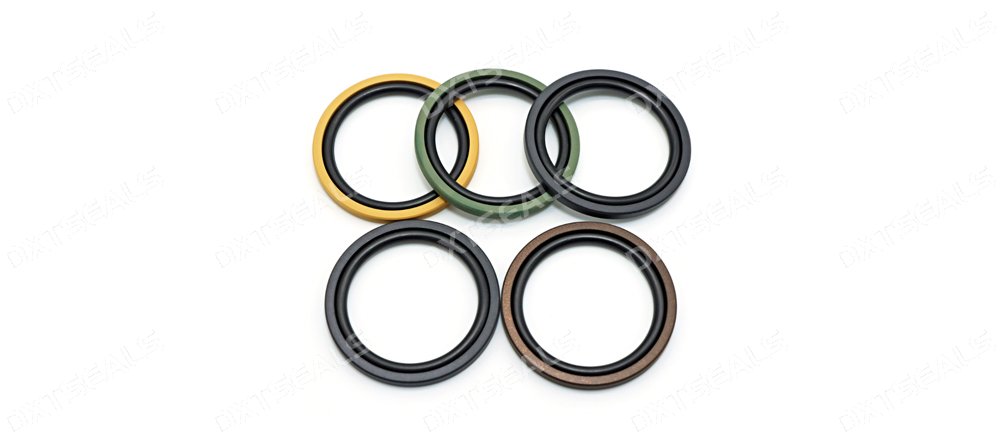
Rubber and plastic sealing materials are widely used in hydraulic equipment, pneumatic systems, pumps, valves, compressors, automotive equipment, industrial machinery, and fluid handling systems.
Choosing the correct material is one of the most important factors in seal performance. A seal that works well with hydraulic oil may not be suitable for hot water, steam, aggressive chemicals, or high-temperature applications.
Common materials include NBR, FKM, EPDM, polyurethane, PTFE, and silicone. Each material has different characteristics in terms of temperature resistance, chemical compatibility, wear resistance, elasticity, friction, and mechanical strength.
Understanding these differences makes it easier to select the right standard seal for a particular application.
What Are Rubber and Plastic Seals?
Rubber seals generally rely on elasticity to create contact pressure between the seal and mating surfaces.
Common rubber sealing materials include:
- NBR
- FKM
- EPDM
- Silicone
- Natural rubber
Plastic and engineered polymer seals generally provide different combinations of low friction, wear resistance, chemical resistance, and temperature performance.
Common polymer sealing materials include:
- PTFE
- Polyurethane
- PEEK
- UHMWPE
- Other engineered plastics
Standard sealing products can be manufactured from these materials in different profiles, including O-rings, oil seals, rod seals, piston seals, wipers, guide rings, and specialized PTFE sealing rings.
NBR Seals
NBR, or nitrile rubber, is one of the most widely used materials for general industrial sealing.
It provides a good balance between cost, mechanical properties, elasticity, and oil resistance.
Advantages of NBR
NBR offers:
- Good resistance to mineral oils
- Good mechanical strength
- Good abrasion resistance
- Good elasticity
- Cost-effective performance
- Wide availability
NBR is commonly used for:
- O-rings
- Hydraulic seals
- Pneumatic seals
- Oil seals
- Gaskets
- General industrial seals
Limitations of NBR
NBR is not the best choice for every environment.
Its performance can be limited by:
- High temperatures
- Ozone exposure
- Weathering
- Certain chemicals
- Some aggressive fluids
For applications involving high temperatures or special chemicals, FKM, PTFE, or another material may be more appropriate.
FKM Seals
FKM is a high-performance fluoroelastomer commonly selected for demanding temperature and chemical environments.
Advantages of FKM
FKM provides good resistance to:
- High temperatures
- Mineral oils
- Fuels
- Many chemicals
- Aging
It is commonly used in:
- Automotive equipment
- Pumps
- Valves
- Chemical equipment
- High-temperature machinery
- Industrial sealing systems
Limitations of FKM
FKM generally costs more than NBR.
It may also have limitations with certain chemicals, hot water, and steam depending on the specific formulation.
Therefore, material compatibility should always be checked against the actual working medium.
EPDM Seals
EPDM is a synthetic rubber widely used in applications involving water, steam, weathering, and many chemicals.
Advantages of EPDM
EPDM offers excellent resistance to:
- Water
- Hot water
- Steam
- Ozone
- UV exposure
- Weathering
- Many chemicals
It is commonly used in:
- Water systems
- Pneumatic equipment
- Valves
- HVAC equipment
- Chemical processing
- Outdoor applications
Important Limitation
EPDM generally has poor compatibility with petroleum-based oils and many hydrocarbon fluids.
For oil-based hydraulic applications, NBR or FKM may be a more suitable choice depending on the temperature and fluid.
Polyurethane Seals
Polyurethane, often abbreviated as PU or PUR, is widely used for dynamic sealing applications.
It combines good elasticity with high mechanical strength and excellent abrasion resistance.
Advantages of Polyurethane
Polyurethane provides:
- Excellent wear resistance
- High tensile strength
- Good tear resistance
- Good elasticity
- Good dynamic performance
- Good resistance to extrusion in suitable formulations
It is commonly used for:
- Hydraulic rod seals
- Piston seals
- Wiper seals
- Pneumatic seals
- Industrial cylinders
Polyurethane is particularly useful for demanding reciprocating applications.
PTFE Seals
PTFE is an important engineering plastic used extensively in industrial sealing.
Unlike conventional elastomers, PTFE provides extremely low friction and excellent chemical resistance.
Advantages of PTFE
PTFE offers:
- Very low friction
- Excellent chemical resistance
- Good temperature resistance
- Low moisture absorption
- Good non-stick characteristics
- Good dimensional stability
PTFE is commonly used for:
- Spring energized seals
- Glyd rings
- Step Seals
- Piston seals
- Rod seals
- Rotary seals
- Static seals
- Custom sealing rings
Filled PTFE
Different fillers can be added to improve the mechanical and wear properties of PTFE.
Common formulations include:
Glass-Filled PTFE
Can improve:
- Wear resistance
- Compressive strength
- Dimensional stability
Carbon-Filled PTFE
Can improve:
- Wear resistance
- Mechanical strength
- Thermal conductivity
Graphite-Filled PTFE
Can help improve:
- Friction characteristics
- Wear resistance
- Thermal performance
Bronze-Filled PTFE
Can improve:
- Load-bearing capability
- Wear resistance
- Thermal conductivity
- Dimensional stability
The appropriate compound should be selected based on the actual operating conditions.
Silicone Seals
Silicone rubber is known for its broad temperature capability and flexibility.
It is commonly used where temperature variation and flexibility are important.
Advantages of Silicone
Silicone provides:
- Wide temperature capability
- Good flexibility
- Good weather resistance
- Good ozone resistance
- Good electrical insulation properties
It can be used in:
- Electrical equipment
- Food-related equipment where the appropriate grade is selected
- Medical equipment
- Industrial applications
- High- and low-temperature environments
Silicone generally has lower abrasion and tear resistance than some polyurethane and other specialized elastomers, so it is not always the best choice for high-wear dynamic applications.
Comparison of Common Sealing Materials
| Material | Oil Resistance | Temperature Resistance | Wear Resistance | Chemical Resistance | Typical Applications |
|---|---|---|---|---|---|
| NBR | Good | Good | Good | Moderate | Oil seals, hydraulic seals |
| FKM | Excellent | Excellent | Good | Excellent* | High-temperature industrial seals |
| EPDM | Poor with mineral oils | Good to Excellent | Good | Excellent* | Water, steam, outdoor applications |
| PU | Good | Good | Excellent | Moderate to Good* | Hydraulic and pneumatic dynamic seals |
| PTFE | Excellent | Excellent | Excellent* | Excellent | Chemical, hydraulic, dynamic seals |
| Silicone | Moderate | Excellent | Moderate | Moderate to Good* | Temperature-sensitive applications |
*Actual performance depends on the specific formulation and working medium.
How to Choose the Right Standard Seal
Material selection should be based on the complete operating environment rather than a single property.
1. Identify the Working Medium
First determine what the seal will contact.
Typical media include:
- Hydraulic oil
- Lubricating oil
- Water
- Steam
- Compressed air
- Fuels
- Solvents
- Chemicals
Fluid compatibility should be checked before selecting the material.
2. Check the Operating Temperature
Consider the complete temperature range:
- Minimum temperature
- Normal operating temperature
- Maximum continuous temperature
- Short-term temperature peaks
Temperature can significantly affect elasticity, hardness, friction, and chemical resistance.
3. Check Operating Pressure
Pressure affects extrusion, contact force, and sealing performance.
High-pressure applications may require:
- Specialized profiles
- Harder materials
- Filled PTFE compounds
- Backup rings
- Optimized extrusion clearance
The seal material should therefore be evaluated together with the seal profile and installation design.
4. Determine the Type of Movement
Identify whether the seal is used for:
- Static sealing
- Reciprocating movement
- Rotary movement
For dynamic applications, friction and wear become particularly important.
PTFE and polyurethane are often considered where low friction or high wear resistance is required.
5. Consider Operating Speed
High-speed movement can increase friction and heat generation.
For high-speed hydraulic or pneumatic equipment, the selection should consider:
- Material friction
- Seal geometry
- Surface finish
- Lubrication
- Operating temperature
6. Evaluate the Environment
External environmental conditions can also affect material selection.
Consider exposure to:
- Dust
- Water
- UV radiation
- Ozone
- Chemicals
- Outdoor weather
- Cleaning agents
For example, EPDM can be advantageous in outdoor and water-related applications, while NBR may be more suitable for many oil-based applications.
Choosing Between Rubber and Plastic Seals
Rubber and plastic sealing materials have different strengths.
When Rubber Is a Good Choice
Rubber seals are often preferred when the application requires:
- High elasticity
- Good low-pressure sealing
- Simple installation
- Cost-effective sealing
- Good conformability
NBR, FKM, EPDM, and silicone each cover different operating environments.
When Plastic or PTFE Is a Better Choice
Polymer seals such as PTFE may be preferred when the application requires:
- Very low friction
- Excellent chemical resistance
- High temperature capability
- Low stick-slip
- High wear resistance
- Specialized dynamic sealing
In many applications, a combination of materials is used rather than relying on a single material.
For example, a Glyd ring may combine a PTFE sealing ring with an NBR or FKM O-ring energizer.
Standard Seal Profiles and Material Selection
Material and seal profile must be considered together.
Common standard products include:
O-Rings
O-rings are simple and versatile static or dynamic sealing elements.
Common materials include NBR, FKM, EPDM, and silicone.
Oil Seals
Oil seals are commonly used for rotating shafts.
NBR, FKM, and other elastomers are widely used depending on the temperature and fluid.
Glyd Rings
Glyd rings are commonly used for piston sealing and typically combine a polymer sealing ring with an elastomer energizer.
Step Seals
Step Seals are commonly used for rod sealing in hydraulic and pneumatic cylinders.
Wiper Seals
Wipers protect cylinders from external contamination and are commonly manufactured from polyurethane or other wear-resistant materials.
Spring Energized Seals
Spring energized seals use a metal spring to provide continuous sealing force and are often manufactured with PTFE or other high-performance polymers.
Standard Sizes and Custom Sealing Solutions
Standard seals are available in many commonly used dimensions.
The advantages of standard products include:
- Easy replacement
- Established dimensions
- Lower production cost
- Shorter procurement time
- Wide availability
However, standard products may not always fit specialized equipment.
Custom sealing products may be required for:
- Non-standard grooves
- Special dimensions
- Unusual pressure conditions
- High temperatures
- Aggressive chemicals
- Special materials
- Limited installation space
Custom rubber and plastic seals can be manufactured according to technical drawings, samples, or OEM specifications.
Precision Manufacturing of Plastic Seals
For non-standard PTFE and other polymer sealing products, precision CNC machining can provide flexible manufacturing options.
Machining can be used for:
- Custom PTFE seals
- Glyd rings
- Step Seals
- Spring energized seal jackets
- Large-diameter sealing rings
- Special piston and rod seals
Important manufacturing factors include:
- Dimensional accuracy
- Profile geometry
- Surface finish
- Material consistency
- Groove compatibility
For specialized applications, close cooperation between the seal manufacturer and equipment designer can help optimize the final sealing solution.
Conclusion
Selecting the right standard seal requires more than simply choosing a material based on price or availability. The working medium, temperature, pressure, movement, speed, environmental conditions, and installation geometry should all be considered.
NBR is a cost-effective choice for many oil-based applications. FKM is suitable for demanding temperature and chemical environments. EPDM performs well with water, steam, and weathering. Polyurethane is widely used for high-wear dynamic hydraulic and pneumatic seals. PTFE provides excellent chemical resistance, very low friction, and broad temperature capability, while silicone is useful for flexible applications involving wide temperature variations.
The correct seal also depends on the profile. O-rings, oil seals, Glyd rings, Step Seals, wipers, and spring energized seals each have different structural characteristics.
For conventional equipment, standard-size rubber and plastic seals provide an economical and convenient solution. When standard products cannot meet specific requirements, professional manufacturers can provide custom rubber and plastic sealing products according to drawings, samples, material specifications, and OEM requirements.