
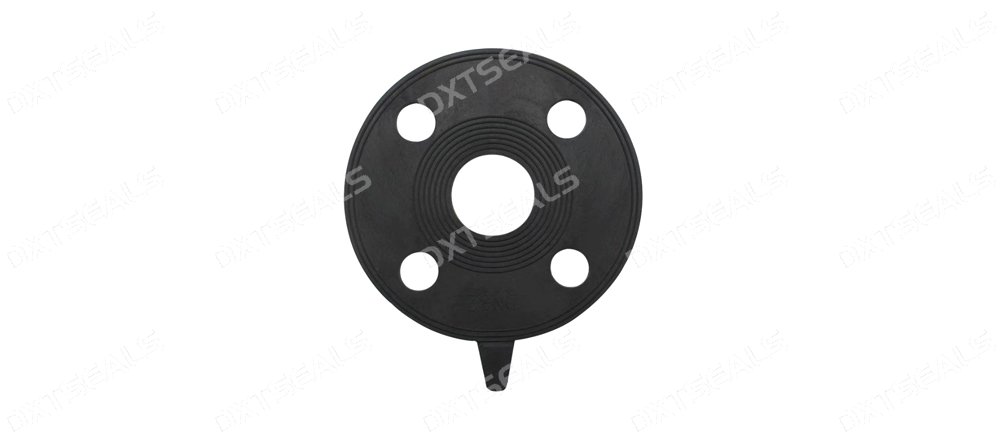
Custom flange gaskets are widely used in industrial piping, equipment, valves, pumps, heat exchangers, and other fluid-handling systems where standard gasket dimensions or materials may not fully meet application requirements. By combining the appropriate sealing material, gasket geometry, thickness, and reinforcement structure, custom flange gaskets can be designed for specific operating conditions.
Unlike a standard gasket selected only by nominal pipe size, a custom flange gasket can be manufactured according to the actual flange dimensions, sealing medium, temperature, pressure, and installation requirements. Material options range from elastomers such as EPDM and NBR to PTFE, FKM, graphite, and reinforced constructions with metal inserts.
What Are Custom Flange Gaskets?
Custom flange gaskets are sealing components manufactured according to specified dimensions, materials, and structural requirements rather than being limited to standard catalog sizes.
They can be customized in several aspects, including:
-
Outer and inner diameter
-
Bolt-hole pattern
-
Gasket thickness
-
Flange sealing geometry
-
Material composition
-
Hardness or grade
-
Reinforcement structure
-
Metal insert dimensions
-
Surface configuration
-
Special operating requirements
Custom manufacturing is particularly useful when a flange has a non-standard size, unusual bolt-hole arrangement, special sealing surface, or limited installation space.
The objective is not simply to make a gasket that fits the flange. The gasket must also provide appropriate sealing behavior under the actual operating conditions.
Custom Flange Gasket Material Options
Material selection is one of the most important factors in custom flange gasket design. Different materials provide different levels of chemical resistance, temperature capability, elasticity, compression behavior, and mechanical stability.
EPDM Flange Gaskets
EPDM is widely used for water-based and outdoor industrial applications because of its excellent resistance to water, ozone, weathering, and aging.
EPDM flange gaskets are commonly used in:
-
Water piping systems
-
HVAC systems
-
Cooling-water systems
-
General industrial water applications
-
Outdoor piping
-
Low-to-moderate temperature sealing applications
EPDM is generally not the preferred material for petroleum-based oils and fuels. The exact performance also depends on the specific EPDM compound and operating conditions.
NBR Flange Gaskets
NBR is commonly selected where resistance to petroleum oils, mineral oils, and many hydraulic fluids is important.
Typical applications include:
-
Hydraulic equipment
-
Oil-handling systems
-
Industrial machinery
-
Petroleum-based fluid systems
-
General mechanical equipment
NBR can provide good sealing performance, but its resistance to ozone, weathering, and elevated temperatures is generally lower than that of many FKM compounds.
FKM Flange Gaskets
FKM is a family of fluoroelastomer compounds known for good high-temperature performance and resistance to many oils, fuels, and chemicals.
FKM flange gaskets can be considered for applications involving:
-
Elevated temperatures
-
Oils and fuels
-
Industrial chemicals
-
Automotive and mechanical equipment
-
Demanding sealing environments
However, FKM should not be treated as universally resistant to every chemical. Compatibility depends on the specific FKM formulation, chemical medium, concentration, temperature, and exposure conditions.
PTFE Flange Gaskets
PTFE is widely selected for applications requiring broad chemical resistance and low friction.
PTFE flange gaskets are commonly considered for:
-
Chemical processing equipment
-
Chemical pipelines
-
Pharmaceutical equipment
-
Water treatment systems
-
Corrosive media
-
Industrial valves and pumps
Virgin PTFE, modified PTFE, expanded PTFE, and filled PTFE can have different mechanical and sealing characteristics. PTFE also has relatively limited elastic recovery compared with elastomers and can experience creep or cold flow under sustained compression. Therefore, gasket design and flange loading are important.
Graphite Flange Gaskets
Graphite is often selected for high-temperature sealing applications where its thermal properties and conformability are advantageous.
Typical applications include:
-
Steam systems
-
Heat-transfer equipment
-
Power-generation equipment
-
Industrial valves
-
High-temperature piping
-
Chemical processing equipment
Graphite performance depends strongly on the grade and environment. In particular, oxidation at elevated temperatures should be considered when selecting graphite sealing materials.
Metal-Reinforced Custom Flange Gaskets
For certain applications, a gasket may require additional structural support. Metal-reinforced flange gaskets incorporate a metal insert, core, or reinforcement layer into the gasket construction.
A common design uses a rubber sealing layer combined with a metal reinforcement.
For example:
Metal Insert + EPDM Sealing Layer = Reinforced EPDM Flange Gasket
The metal reinforcement can help improve dimensional stability, structural support, and handling characteristics.
Advantages of Metal Reinforcement
Metal reinforcement can provide several practical benefits:
-
Improved dimensional stability
-
Greater structural support
-
Easier handling during installation
-
Reduced deformation during assembly
-
Improved resistance to distortion in suitable designs
-
Support for large or complex gasket geometries
The metal insert does not automatically increase the pressure rating of a gasket. The overall performance depends on the sealing material, reinforcement design, flange construction, bolt loading, temperature, pressure, and operating medium.
Metal Insert Materials for Custom Gaskets
Different metal materials can be selected depending on the application.
Common options may include:
-
Carbon steel
-
Stainless steel
-
304 stainless steel
-
316/316L stainless steel
-
Other corrosion-resistant alloys
The selection of the reinforcement material should consider the surrounding environment, corrosion conditions, temperature, mechanical requirements, and compatibility with the sealing material.
For corrosive industrial environments, stainless steel reinforcement may provide advantages over conventional carbon steel.
Custom EPDM Flange Gaskets with Metal Inserts
Reinforced EPDM flange gaskets are a useful example of combining elastomeric sealing properties with metal structural support.
The EPDM layer provides the primary sealing interface, while the metal insert can provide additional dimensional stability.
This construction can be useful when a conventional rubber gasket is too flexible or difficult to handle because of its size or geometry.
Custom reinforced EPDM gaskets can be manufactured with different:
-
Rubber grades
-
Hardness levels
-
Metal insert materials
-
Insert thicknesses
-
Inner and outer diameters
-
Bolt-hole patterns
-
Overall gasket thicknesses
The final configuration should be determined according to the actual flange and operating conditions.
Custom Flange Gasket Design Considerations
A reliable custom gasket begins with accurate application information.
1. Flange Dimensions
Important dimensional information may include:
-
Inner diameter
-
Outer diameter
-
Bolt-hole diameter
-
Number of bolt holes
-
Bolt-hole pitch circle diameter
-
Flange thickness
-
Sealing-face dimensions
For non-standard equipment, a drawing or dimensional specification can be used as the manufacturing reference.
2. Flange Standard
The gasket should correspond to the applicable flange standard and dimensions.
Common systems include:
-
ASME
-
ANSI
-
EN
-
DIN
-
JIS
-
Other industrial or customer-specific standards
American systems commonly use NPS and pressure Class designations, while European systems commonly use DN and PN designations. These designations should not be treated as direct one-to-one equivalents without checking the actual flange dimensions.
3. Flange Face Configuration
The gasket geometry must match the flange sealing surface.
Common configurations include:
-
Full-face gaskets
-
Raised-face gaskets
-
Flat-face configurations
-
Ring-type gasket geometries
-
Custom sealing profiles
Using an incorrect gasket geometry can result in poor compression, leakage, or installation problems.
4. Operating Temperature
Temperature affects both elastomeric and non-elastomeric gasket materials.
When selecting a material, consider:
-
Minimum operating temperature
-
Normal operating temperature
-
Maximum operating temperature
-
Temperature cycling
-
Thermal expansion
-
Exposure duration
Actual temperature capability should always be confirmed using the specific material grade and manufacturer data.
5. Operating Pressure
Pressure is another important factor in gasket selection.
The complete sealing assembly should be evaluated rather than considering gasket material alone. Flange stiffness, bolt load, gasket thickness, gasket geometry, temperature, and pressure cycling can all influence sealing performance.
6. Sealing Medium
Chemical compatibility is essential.
The gasket may be exposed to:
-
Water
-
Steam
-
Hydraulic oil
-
Mineral oil
-
Fuels
-
Acids
-
Alkalis
-
Solvents
-
Process chemicals
-
Compressed gases
The exact chemical composition, concentration, temperature, and exposure time should be considered before selecting the gasket material.
Custom Flange Gaskets for Industrial Applications
Custom flange gaskets are used across many industrial sectors.
Chemical Processing
Chemical equipment often requires gasket materials with specific chemical resistance. PTFE, modified PTFE, graphite, FKM, and other specialized materials may be considered depending on the medium.
Water Treatment
EPDM is commonly used for many water-related applications because of its good water resistance and environmental durability.
Oil and Hydraulic Equipment
NBR and FKM are commonly considered for applications involving oils and hydraulic fluids, depending on temperature and fluid composition.
Power and Steam Systems
Graphite and other high-temperature gasket constructions may be used in steam and thermal applications where appropriate.
Pumps and Valves
Custom flange gaskets can be manufactured for pump casings, valve bodies, pipe connections, and other equipment where standard gasket dimensions are unavailable.
Heat Exchangers
Heat exchanger applications may require specialized gasket materials, dimensions, and sealing geometries according to the equipment design and operating conditions.
Custom Gasket Manufacturing Process
A typical custom flange gasket manufacturing process includes several stages.
Step 1: Review Application Requirements
The required material, dimensions, temperature, pressure, medium, and flange configuration are evaluated.
Step 2: Confirm Drawing and Dimensions
Engineering drawings, samples, flange measurements, or customer specifications can be used to establish the gasket geometry.
Step 3: Select the Sealing Material
The material is selected according to chemical compatibility, temperature, pressure, compression behavior, and application requirements.
Step 4: Design Reinforcement if Required
For reinforced gaskets, the metal insert material, thickness, shape, and position are determined according to the gasket structure.
Step 5: Manufacture the Gasket
Depending on the material and design, manufacturing may involve cutting, molding, machining, punching, or other suitable processes.
Step 6: Inspection
Critical dimensions, material specifications, sealing geometry, and reinforcement configuration can be inspected before shipment.
Custom Flange Gaskets vs Standard Gaskets
Standard flange gaskets are convenient when the flange dimensions and operating conditions match established specifications. However, custom gaskets provide greater flexibility for special applications.
| Feature | Standard Flange Gasket | Custom Flange Gasket |
|---|---|---|
| Dimensions | Standardized | Customer-specific |
| Materials | Common material grades | Multiple material options |
| Bolt-hole pattern | Standard | Custom |
| Thickness | Standard options | Customizable |
| Metal reinforcement | Limited configurations | Custom reinforcement possible |
| Non-standard equipment | May not fit | Suitable for special dimensions |
| Application optimization | General | Application-specific |
Custom manufacturing is particularly valuable when the equipment uses non-standard dimensions or when the sealing requirements cannot be met effectively by an off-the-shelf gasket.
How to Specify a Custom Flange Gasket
When requesting a custom flange gasket, providing complete information can help improve manufacturing accuracy.
A useful specification may include:
| Parameter | Example Information |
|---|---|
| Gasket type | Full-face / ring gasket / custom profile |
| Material | EPDM / NBR / FKM / PTFE / graphite |
| Reinforcement | None / stainless steel insert |
| Inner diameter | Customer drawing |
| Outer diameter | Customer drawing |
| Bolt holes | Quantity and dimensions |
| Thickness | Required gasket thickness |
| Flange standard | ASME / EN / DIN / JIS / custom |
| Medium | Water / oil / steam / chemical |
| Temperature | Minimum and maximum |
| Pressure | Operating pressure |
| Application | Pipe / pump / valve / heat exchanger |
Providing a technical drawing or existing gasket sample can further simplify the customization process.
Choosing the Right Custom Flange Gasket Manufacturer
A capable gasket manufacturer should be able to support more than simple dimensional cutting.
Important capabilities may include:
-
Multiple sealing material options
-
Custom dimensions
-
Non-standard bolt-hole patterns
-
Rubber molding or cutting
-
PTFE machining or cutting
-
Metal insert reinforcement
-
Custom gasket profiles
-
Technical drawing review
-
Dimensional inspection
-
Small-batch and OEM production
For complex applications, manufacturing experience with both sealing materials and reinforced gasket structures can be particularly valuable.
Conclusion
Custom flange gaskets provide a flexible solution for industrial sealing applications where standard gasket sizes or materials are not sufficient. By selecting the appropriate sealing material and gasket geometry, manufacturers can address different requirements involving temperature, pressure, chemical compatibility, and flange configuration.
Material options such as EPDM, NBR, FKM, PTFE, and graphite provide different performance characteristics, while metal reinforcement can add structural support and dimensional stability to suitable gasket designs.
For OEM equipment, replacement parts, non-standard flanges, and demanding industrial applications, custom flange gaskets can be manufactured according to specific drawings, dimensions, materials, and operating conditions. A combination of accurate engineering specifications, appropriate material selection, and controlled manufacturing is essential for achieving reliable flange sealing performance.