
Introduction
In critical sealing applications, elastic recovery and long-term reliability are essential for maintaining system integrity. Among various metal sealing solutions, metal C-rings are widely recognized for their ability to combine flexibility with durability.
Thanks to their unique open cross-section, C-rings provide excellent elastic recovery, making them suitable for environments involving thermal expansion, pressure fluctuations, and repeated loading cycles.
In this article, we analyze the elastic recovery characteristics and sealing reliability of metal C-rings, helping engineers better understand their advantages. At DXTSEALS, we specialize in high-performance C-ring sealing solutions for demanding industries.
1. Structural Basis of Elastic Recovery
Open “C” Shaped Cross-Section
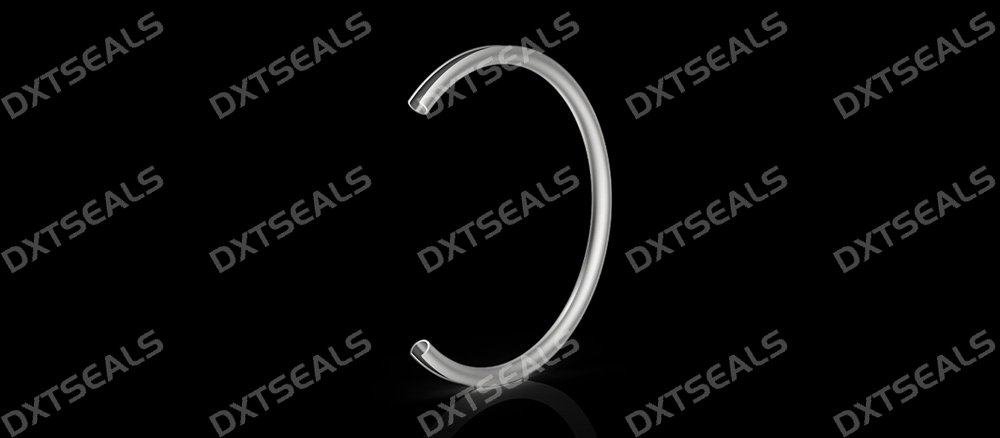
The defining feature of a metal C-ring is its open “C” shaped geometry, which acts similarly to a spring. This structure allows the seal to:
- Deform elastically under compression
- Store mechanical energy
- Recover its shape after load removal
This spring-like behavior is the foundation of its elastic recovery performance.
Thin-Walled Construction
Most metal C-rings are designed with relatively thin walls, which:
- Enhance flexibility
- Reduce required compression force
- Improve responsiveness to pressure changes
This design ensures that the seal can adapt to varying operating conditions.
2. Mechanism of Elastic Recovery
Compression and Energy Storage
During installation, the C-ring is compressed between mating surfaces. This compression:
- Generates initial contact stress
- Stores elastic energy within the structure
Recovery After Load Changes
When external forces fluctuate (e.g., pressure drops or thermal contraction):
- The stored energy drives the seal to recover
- Contact pressure is maintained
- Sealing integrity is preserved
This ability to continuously adjust contact pressure is key to long-term sealing reliability.
3. Factors Affecting Elastic Recovery Performance
Material Properties
The base material plays a critical role in recovery behavior. Common materials include:
- Stainless steel
- Inconel
- Hastelloy
These materials offer:
- High yield strength
- Good fatigue resistance
- Stability under extreme temperatures
Surface Coatings
Soft metal coatings such as silver or gold can improve sealing but may slightly affect recovery if not properly controlled. Their benefits include:
- Enhanced surface conformity
- Reduced leakage
- Lower friction
Design Parameters
Key design factors influencing recovery include:
- Wall thickness
- C-ring opening angle
- Diameter and cross-section size
Optimizing these parameters ensures the best balance between flexibility and strength.
4. Sealing Reliability of Metal C-Rings
Consistent Contact Pressure
Elastic recovery allows the C-ring to maintain:
- Continuous contact with sealing surfaces
- Stable sealing force over time
Even under thermal cycling or pressure variation, the seal remains effective.
Adaptability to Surface Irregularities
Thanks to its flexibility, the C-ring can:
- Compensate for minor surface imperfections
- Maintain sealing performance on less-than-perfect flanges
This reduces the risk of leakage in real-world conditions.
Resistance to Fatigue and Deformation
High-quality metal C-rings are designed to:
- Withstand repeated loading cycles
- Resist permanent deformation
- Maintain performance over long service periods
This contributes to high reliability in demanding applications.
5. Typical Applications
Metal C-rings are widely used in environments where elastic recovery is critical:
Aerospace
- Engine sealing systems
- High-temperature components
- Pressure control systems
Oil & Gas
- High-pressure pipelines
- Flange connections
- Subsea equipment
Power Generation
- Gas turbines
- Heat exchangers
- Nuclear systems
Semiconductor Industry
- Vacuum chambers
- High-purity gas sealing
These applications require stable, long-term sealing under extreme conditions.
6. Advantages Over Other Metal Seals
Compared to other metal sealing rings:
- Better recovery than solid metal O-rings
- Lower installation force than rigid seals
- Good balance between flexibility and strength
While E-rings may offer higher leak tightness, C-rings provide a cost-effective and reliable solution for many industrial applications.
Conclusion
Metal C-rings offer a unique combination of elastic recovery and sealing reliability, making them ideal for applications involving thermal cycling, pressure variation, and surface irregularities.
Their spring-like structure allows them to:
- Maintain consistent contact pressure
- Adapt to changing conditions
- Deliver long-term sealing performance
At DXTSEALS, we are committed to providing precision-engineered metal C-rings designed for maximum reliability and efficiency.
If you need high-performance C-ring sealing solutions or technical support, contact DXTSEALS today for customized designs and expert guidance.