
1. Introduction
EPDM flange gaskets are widely used in industrial piping systems where water resistance, weather durability, and reliable sealing are important. Manufactured from ethylene propylene diene monomer (EPDM) rubber, these gaskets provide effective sealing between mating flange surfaces in a variety of industrial and commercial applications.
EPDM is particularly valued for its resistance to ozone, outdoor weathering, and many water-based media. These properties make EPDM flange gaskets suitable for water supply systems, HVAC equipment, cooling circuits, water treatment facilities, and other applications where the process medium is compatible with the rubber compound.
However, EPDM is not suitable for every fluid or operating condition. Factors such as temperature, pressure, chemical composition, flange design, and gasket dimensions must be considered before selecting a material.
This article explores the advantages, material properties, and industrial applications of EPDM flange gaskets and explains how to choose the right gasket for dependable sealing performance.
2. What Is an EPDM Flange Gasket?
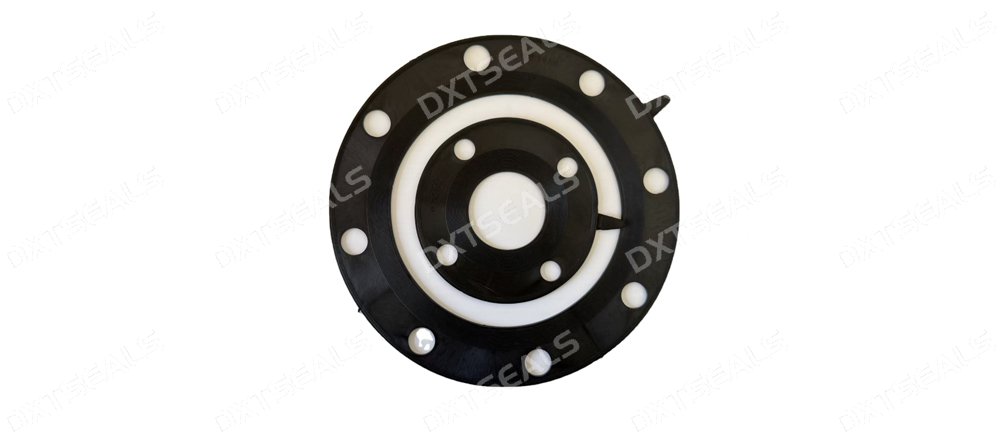
An EPDM flange gasket is a rubber sealing component installed between two mating flanges. When the flange bolts are tightened, the gasket compresses to accommodate surface irregularities and create a seal that helps prevent fluid leakage.
EPDM rubber is a synthetic elastomer known for its resistance to weathering, ozone, and many aqueous environments. Its formulation can be adjusted to provide different hardness levels, mechanical properties, and performance characteristics.
EPDM flange gaskets are available in different shapes and dimensions, including:
-
Full-face flange gaskets with bolt holes.
-
Ring-type flange gaskets.
-
Flat rubber gaskets cut from EPDM sheet material.
-
Custom-shaped gaskets manufactured according to drawings or samples.
-
Different thicknesses and hardness grades for specific sealing requirements.
The correct gasket configuration depends on the flange facing, dimensional standard, operating conditions, and required sealing performance.
3. Key Material Properties of EPDM Rubber
Understanding the properties of EPDM helps determine whether it is suitable for a particular industrial sealing application.
3.1 Excellent Water Resistance
EPDM provides good resistance to water and many water-based fluids. It is widely used in systems involving cold water, hot water, cooling water, and other compatible aqueous media.
This property makes EPDM a common material choice for water distribution networks, HVAC systems, and water treatment equipment.
For hot-water and steam applications, the specific EPDM compound must be rated for the actual temperature, exposure duration, and operating conditions.
3.2 Outstanding Ozone and Weather Resistance
One of the major advantages of EPDM is its resistance to ozone, sunlight, and outdoor weathering.
Compared with many general-purpose rubber compounds, EPDM can maintain its useful properties under prolonged outdoor exposure when correctly formulated and used within its design limits.
This makes EPDM flange gaskets suitable for outdoor piping, exposed equipment, and installations subject to changing weather conditions.
3.3 Good Flexibility and Elasticity
EPDM rubber is flexible and can conform to minor irregularities on mating flange surfaces when compressed appropriately.
Its elasticity helps establish sealing contact and accommodate small variations in surface condition. The actual sealing performance depends on hardness, gasket thickness, flange flatness, compression, and bolt loading.
Excessive compression should be avoided because it may cause damage or accelerate material degradation.
3.4 Resistance to Many Chemicals
EPDM offers good compatibility with many aqueous solutions and selected acids, alkalis, and other chemicals.
However, chemical resistance depends on the specific substance, concentration, temperature, and EPDM formulation. Compatibility should be verified before the gasket is used in chemical processing equipment.
EPDM is generally unsuitable for petroleum-based oils, fuels, and many hydrocarbon fluids.
3.5 Electrical Insulation Properties
EPDM is an electrical insulating material and may be used in certain assemblies where electrical isolation is required in addition to sealing.
For flange insulation applications, the complete design must account for the gasket, sleeves, washers, flange configuration, and required electrical performance. Standard EPDM material properties alone do not establish the insulation rating of an assembled kit.
4. Main Advantages of EPDM Flange Gaskets
EPDM flange gaskets offer several benefits for compatible industrial applications.
4.1 Long-Term Weather Durability
EPDM's resistance to ozone and weathering helps reduce deterioration in outdoor environments. This can be valuable for piping systems installed outside buildings or in exposed industrial areas.
Actual service life still depends on temperature, compression, chemical exposure, and installation quality.
4.2 Reliable Sealing for Water Systems
EPDM is frequently used in water-related applications because it combines useful elasticity with resistance to many aqueous media.
It can be suitable for water supply, cooling circuits, HVAC systems, and water treatment equipment when the compound meets the relevant service requirements.
4.3 Flexible Material and Design Options
EPDM gaskets can be manufactured in various thicknesses, hardness grades, and shapes. This allows the gasket design to be matched to different flange configurations and installation requirements.
Both standard products and non-standard custom gaskets can be considered depending on the application.
4.4 Cost-Effective Industrial Sealing
For applications where EPDM is chemically and thermally suitable, it can offer an economical sealing solution.
Material availability, straightforward gasket cutting, and the option to use standard dimensions can help simplify procurement and maintenance.
The lowest-cost gasket is not always the most economical choice, however. Compatibility and expected service life should be evaluated together.
4.5 Suitability for Different Flange Configurations
EPDM sheet material can be converted into different gasket shapes, including full-face and ring-type designs.
The gasket must match the flange facing and dimensions to ensure proper contact and avoid installation problems.
5. Industrial Applications of EPDM Flange Gaskets
EPDM flange gaskets are used across multiple industries where their material characteristics match the operating environment.
5.1 Water Supply and Distribution
EPDM gaskets are commonly used in water pipelines, distribution equipment, reservoirs, and related connections.
Important selection factors include water composition, temperature, operating pressure, flange type, and any applicable drinking-water or regulatory requirements.
For potable-water applications, select a compound with the required approvals rather than assuming that all EPDM materials are suitable.
5.2 HVAC and Cooling Systems
Heating, ventilation, and air-conditioning systems often use EPDM flange gaskets in compatible water and cooling-fluid circuits.
Their resistance to water and outdoor weathering makes them useful in chilled-water pipelines, cooling equipment, and building service systems.
For glycol-containing fluids or other additives, verify the compatibility of the exact formulation and concentration.
5.3 Water Treatment Facilities
Water treatment plants use flange gaskets in filtration systems, piping networks, pumps, tanks, and treatment equipment.
EPDM may be appropriate for compatible water-based media, but the presence of disinfectants, cleaning chemicals, or concentrated treatment agents must be considered.
5.4 Industrial Cooling Water Systems
Industrial cooling circuits often operate continuously and may include outdoor piping and temperature fluctuations.
EPDM flange gaskets can provide suitable sealing performance when the cooling medium and operating conditions are compatible with the selected compound.
5.5 Outdoor Piping and Utility Systems
EPDM's weather and ozone resistance makes it a useful option for exposed piping installations.
However, the complete application must be reviewed for fluid compatibility, pressure, temperature cycling, mechanical loading, and installation conditions.
6. EPDM Flange Gasket Temperature and Pressure Considerations
Temperature and pressure are essential factors when choosing EPDM flange gaskets.
Temperature Performance
EPDM is available in formulations designed for different temperature ranges. Its actual operating limits depend on the compound, gasket design, exposure duration, and process medium.
Before selecting an EPDM gasket, confirm:
-
Minimum operating temperature.
-
Normal continuous operating temperature.
-
Maximum temperature and any short-term peaks.
-
Whether the system experiences frequent temperature cycling.
-
Whether the fluid affects the material at elevated temperatures.
Hot water and steam should not be treated as identical service conditions. A compound suitable for hot water may not be suitable for continuous steam exposure.
Pressure Performance
EPDM flange gaskets do not have one universal pressure rating. Pressure capability depends on gasket thickness, hardness, flange geometry, surface condition, bolt loading, and the overall joint design.
For reliable performance:
-
Confirm the flange standard and pressure designation.
-
Match the gasket dimensions to the flange.
-
Ensure that the gasket has adequate support.
-
Follow the specified bolt-tightening procedure.
-
Avoid excessive or uneven compression.
The flange assembly must be evaluated as a complete sealing system rather than by gasket material alone.
7. EPDM vs. Other Flange Gasket Materials
Although EPDM is useful in many water-based applications, alternative materials may be more suitable when the process involves oils, aggressive chemicals, or higher temperatures.
| Material | Main Strengths | Main Limitations | Typical Applications |
|---|---|---|---|
| EPDM | Water resistance, ozone resistance, weather durability | Generally unsuitable for petroleum-based oils and fuels | Water systems, HVAC, outdoor piping |
| NBR | Good resistance to many oils and hydraulic fluids | Generally lower weather and ozone resistance than EPDM | Oil systems, industrial machinery |
| FKM | Good resistance to many oils, fuels, and elevated temperatures | Higher cost; chemical compatibility varies by grade | Industrial equipment, fuel systems |
| PTFE | Excellent resistance to a broad range of chemicals | Creep and cold flow may affect sealing performance | Chemical processing, corrosive media |
| Graphite | Good high-temperature sealing capability under suitable conditions | Oxidation and strong-oxidizer limitations | Steam systems, heat exchangers |
| Spiral wound | Resilient metal-and-filler construction | Requires correct specification and flange installation | Pressure piping, process equipment |
EPDM vs. NBR
EPDM is generally preferred for compatible water-based media and outdoor exposure. NBR is often more suitable for petroleum-based oils and hydraulic fluids.
The two materials should not be substituted for one another without checking the process medium.
EPDM vs. PTFE
EPDM provides elastic conformity and is often economical for compatible water systems. PTFE offers broader chemical resistance but has different mechanical behavior and may be more susceptible to creep under sustained loading.
EPDM vs. Graphite
EPDM is commonly used for water-based service within its rated temperature range. Graphite is frequently selected for demanding high-temperature applications, provided the atmosphere and process chemistry are compatible.
The right choice depends on the actual operating conditions rather than material cost alone.
8. American and European Flange Standards
Industrial EPDM flange gaskets must match the dimensions and configuration of the mating flanges.
Common standards include ASME B16.5 and ASME B16.47 for applicable American flange systems, and the EN 1092 series for relevant European flange systems.
American projects commonly use NPS size designations and Class pressure designations, while European systems commonly use DN and PN designations.
These systems should not be assumed to be directly interchangeable. The gasket must match the actual flange dimensions, facing, bolt-hole arrangement where applicable, and project specification.
Important Dimensional Factors
When ordering EPDM flange gaskets, confirm:
-
Applicable flange standard.
-
Nominal pipe size or DN.
-
Pressure designation.
-
Flange facing.
-
Gasket inside and outside diameters.
-
Bolt-hole count and layout for full-face designs.
-
Required gasket thickness.
For replacement applications, verify the dimensions against the original drawing or actual flange rather than relying on nominal size alone.
9. Full-Face vs. Ring-Type EPDM Flange Gaskets
EPDM flange gaskets are available in different configurations.
Full-Face EPDM Gaskets
Full-face gaskets generally cover the flange face and include bolt holes. They are commonly used with flat-face flanges where the gasket is supported across the flange face.
Their outside dimensions and bolt-hole arrangement must match the flange.
Ring-Type EPDM Gaskets
Ring-type gaskets fit within the sealing area of the flange and are often used with raised-face flange arrangements when the dimensions are appropriate.
Their inside and outside diameters must provide the correct sealing contact without obstructing the flow path.
How to Choose
The gasket type should be selected according to the flange facing, dimensional standard, joint design, and equipment requirements. Full-face and ring-type gaskets should not be treated as interchangeable solely because their nominal sizes are the same.
10. How to Select the Right EPDM Flange Gasket
A structured selection process helps reduce leakage risks and improve gasket service life.
Step 1: Identify the process medium. Confirm whether the system contains water, cooling fluid, a chemical solution, or another compatible medium.
Step 2: Verify chemical compatibility. Check the specific EPDM compound against the fluid composition and concentration.
Step 3: Confirm the temperature range. Include continuous operating temperature, short-term peaks, and temperature cycling.
Step 4: Evaluate pressure conditions. Review operating pressure, pressure fluctuations, flange support, and joint design.
Step 5: Identify the flange standard. Confirm the applicable ASME, EN, or other dimensional specification.
Step 6: Select the gasket configuration. Determine whether a full-face or ring-type gasket is required.
Step 7: Confirm dimensions and thickness. Verify all dimensions against the flange drawing or equipment specification.
Step 8: Review installation requirements. Follow the specified bolt-tightening procedure and ensure the mating surfaces are suitable for sealing.
11. Custom EPDM Flange Gasket Manufacturing
Standard EPDM flange gaskets cover many common applications, but some industrial systems require non-standard sizes, special shapes, or specific material properties.
Custom EPDM gaskets can be manufactured according to technical drawings, samples, measurements, or equipment requirements.
Common customization options include:
-
Non-standard inner and outer diameters.
-
Special gasket thicknesses.
-
Full-face and ring-type configurations.
-
Different hardness grades.
-
Custom shapes and cutouts.
-
Specific material compound requirements.
-
OEM and replacement gasket production.
When requesting a quotation, provide the gasket drawing or dimensions, flange standard, operating temperature, pressure, process medium, and any special approval requirements.
These details help the manufacturer determine whether EPDM is appropriate and identify the required gasket specification.
12. Common EPDM Flange Gasket Selection Mistakes
Several mistakes can reduce sealing performance:
-
Using EPDM with incompatible oils or fuels: EPDM is generally unsuitable for petroleum-based oils and fuels.
-
Ignoring the temperature rating: A compound may deteriorate if used outside its specified operating conditions.
-
Assuming all EPDM compounds are identical: Formulation affects chemical resistance and service life.
-
Choosing incorrect dimensions: An unsuitable gasket may not seal properly or may interfere with installation.
-
Ignoring flange facing: Full-face and ring-type gaskets are designed for different flange configurations.
-
Overlooking installation quality: Uneven bolt loading, poor alignment, and damaged surfaces can cause leakage.
-
Assuming a universal pressure rating: The complete flange joint and gasket design determine pressure capability.
Avoiding these mistakes helps improve sealing reliability and reduce maintenance requirements.
Conclusion
EPDM flange gaskets are an effective sealing option for many water-based industrial systems, HVAC installations, cooling circuits, water treatment facilities, and outdoor piping applications. Their main advantages include water resistance, ozone resistance, weather durability, flexibility, and cost-effective manufacturing.
However, EPDM is not suitable for every medium or operating condition. Temperature, pressure, chemical compatibility, flange standards, gasket dimensions, and installation quality must all be evaluated before selecting a gasket.
By choosing the appropriate EPDM compound and gasket configuration, industrial users can achieve dependable sealing performance and improve equipment service life. Standard EPDM flange gaskets and custom-manufactured solutions can both be specified to meet different industrial requirements.