
Introduction
Manufacturing extra-large custom components requires CNC equipment with significantly greater working capacity than conventional machining centers. When a component exceeds the machining envelope of standard CNC equipment, gantry CNC machining can provide the large working area, structural support, and machining flexibility required for the job.
Gantry CNC machines are widely used for large plates, structural components, machine bases, molds, housings, covers, industrial equipment parts, and other oversized custom components. They can also be valuable for machining large engineering plastic and graphite components that require a substantial working envelope.
However, machining a very large component is not simply a matter of putting a large workpiece onto a large machine. Maintaining dimensional accuracy across a large area introduces challenges related to machine geometry, thermal expansion, workholding, material deformation, cutting forces, tool deflection, programming, and inspection.
This article examines the capabilities of gantry CNC machining and the major production challenges involved in manufacturing extra-large custom parts.
What Is Gantry CNC Machining?
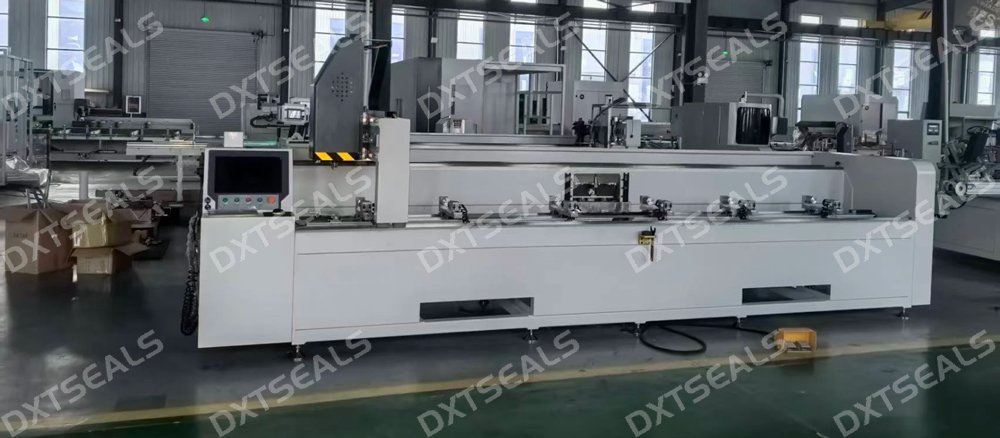
Gantry CNC machining uses a bridge-like machine structure that spans the worktable. The cutting head travels along the gantry while the machine axes control the position of the cutting tool relative to the workpiece.
Compared with conventional vertical machining centers, gantry machines can provide a substantially larger machining envelope.
Depending on the machine configuration, gantry CNC equipment may offer:
-
Large X-axis travel
-
Large Y-axis travel
-
Extended Z-axis clearance
-
Large table dimensions
-
High workpiece load capacity
-
Powerful spindles
-
Multiple tool options
-
Large-format milling capability
The exact machine configuration varies between manufacturers. Some gantry systems are optimized for heavy metal machining, while others are designed for large-format precision milling of plastics, composites, graphite, or other specialized materials.
Why Use Gantry CNC Machining for Extra-Large Parts?
The primary advantage of gantry CNC machining is its ability to handle components that exceed the practical size limitations of conventional CNC equipment.
Large-format gantry machining can be used when a component requires:
-
Very large machining dimensions
-
Large flat surfaces
-
Multiple machining features across a wide area
-
Large pockets or cavities
-
Precision hole patterns
-
Large contours
-
Oversized plates or covers
-
Complex custom geometries
Instead of dividing a large component into several smaller pieces and assembling them later, gantry CNC machining can sometimes produce the component as a single integrated part.
This can eliminate certain assembly interfaces and help maintain dimensional relationships between features.
Key Capabilities of Gantry CNC Machining
1. Extra-Large Working Envelope
The most obvious capability of a gantry CNC machine is its large working area.
The actual available envelope depends on the machine, but large-format equipment can accommodate workpieces that would be impossible to process on standard machining centers.
Important specifications include:
-
Maximum X-axis travel
-
Maximum Y-axis travel
-
Maximum Z-axis travel
-
Table dimensions
-
Gantry opening
-
Maximum workpiece height
-
Maximum workpiece weight
When selecting equipment, the entire workholding and tool-access requirements must be considered rather than looking only at the nominal axis travel.
2. Large-Surface Milling
Gantry CNC machines are particularly useful for machining large flat or contoured surfaces.
Typical applications include:
-
Large plates
-
Machine bases
-
Equipment frames
-
Structural components
-
Covers
-
Large mounting surfaces
-
Industrial housings
Large surfaces can require careful toolpath planning because even small variations in machine geometry, thermal conditions, or workpiece deformation can affect the final result.
3. Heavy and Large Workpieces
Large industrial components can be extremely heavy.
A gantry CNC machine designed for heavy machining can provide the rigidity and table capacity needed for large metal components.
However, the machine's rated load capacity should always be matched to the actual workpiece weight and support arrangement.
The weight of the component is only one factor. Its shape and stiffness also influence how it should be supported during machining.
4. Machining Large Custom Plates and Covers
Large custom plates and covers are common applications for gantry CNC machining.
These components may contain:
-
Large openings
-
Mounting holes
-
Slots
-
Recesses
-
Sealing grooves
-
Counterbores
-
Step features
-
Complex contours
For components used in industrial equipment or sealing systems, dimensional relationships between these features may be critical for assembly.
5. Large-Format PTFE CNC Machining
Gantry CNC machining can be particularly valuable for oversized PTFE components.
PTFE is widely used in industrial applications because of its chemical resistance, low friction, and sealing performance.
Large PTFE custom parts may include:
-
PTFE plates
-
PTFE covers
-
PTFE grid plates
-
Large sealing plates
-
Custom PTFE blocks
-
Large rings
-
Chemical-resistant components
-
Insulating components
When a PTFE component exceeds the working range of a conventional CNC mill, large gantry equipment can provide the required machining envelope.
However, PTFE machining requires special process considerations because the material is relatively soft and has a relatively high coefficient of thermal expansion.
Clamping force, cutting heat, material condition, and inspection temperature can all influence dimensional results.
Gantry CNC Machining of Large Graphite Components
Graphite and carbon graphite are another category of material that may require specialized large-format CNC machining.
Large graphite components can be used in:
-
Industrial sealing systems
-
High-temperature equipment
-
Electrical applications
-
Furnace components
-
Specialized mechanical assemblies
Graphite can be relatively brittle and abrasive, so machining requires suitable cutting tools and process parameters.
Dust management is also important because graphite machining can generate fine particles.
For oversized graphite components, the manufacturer must consider both machining accuracy and the physical handling of the finished part.
Large-Scale Gantry Machining Process
The manufacturing process for an extra-large custom component generally requires more detailed planning than standard CNC machining.
Step 1: Drawing and Geometry Review
The manufacturer first evaluates:
-
Overall dimensions
-
Material
-
Critical tolerances
-
Surface finish
-
Datum requirements
-
Feature locations
-
Flatness
-
Parallelism
-
Perpendicularity
-
Machining depth
-
Inspection requirements
This determines whether the component can be manufactured efficiently on the available gantry equipment.
Step 2: Material Preparation
The raw material must be large enough to provide the required finished dimensions while allowing sufficient machining allowance.
For large components, material condition can be particularly important.
Internal stresses in metal, plastics, and other materials may cause dimensional movement during material removal.
Step 3: Workholding and Alignment
The component is positioned and supported on the machine table.
For large parts, support distribution becomes critical.
The manufacturer may need to use multiple support points to prevent:
-
Sagging
-
Vibration
-
Part movement
-
Clamping deformation
The machining datum must also be established accurately.
Step 4: Rough Machining
Rough machining removes the majority of excess material.
For large components, the material-removal sequence should be carefully planned to avoid excessive localized stress or deformation.
High-efficiency roughing may be combined with controlled cutting parameters depending on the material and machine capability.
Step 5: Semi-Finishing
Semi-finishing establishes more accurate surfaces and features before the final machining operation.
This stage can help stabilize the component and prepare critical surfaces for finishing.
Step 6: Final Finishing
Finishing operations focus on the required dimensional accuracy, surface finish, and geometric tolerances.
Large flat surfaces may require carefully controlled finishing toolpaths.
Step 7: Inspection
The finished component is inspected against the engineering drawing.
Depending on the part, inspection may include:
-
Dimensional measurement
-
Flatness measurement
-
Hole-position verification
-
Surface-finish inspection
-
Parallelism measurement
-
Perpendicularity verification
-
CMM or portable measurement
-
CNC probing
Major Production Challenges of Gantry CNC Machining
1. Maintaining Accuracy Across a Large Area
One of the biggest challenges is maintaining dimensional accuracy over a very large machining envelope.
A tolerance that is relatively easy to maintain on a small component may become significantly more difficult when applied across a large component.
Machine alignment, axis accuracy, thermal expansion, tool deflection, and workpiece movement all become more important as the machining area increases.
2. Thermal Expansion
Thermal effects are particularly important for extra-large components.
The workpiece and machine may operate at different temperatures during machining and inspection.
Metal components can expand or contract with temperature changes, while materials such as PTFE can exhibit much greater dimensional changes due to temperature.
For precision oversized components, temperature control and consistent inspection conditions can therefore be essential.
3. Workpiece Deformation
A large component may be dimensionally stable in one condition and deform after being unclamped.
This is especially relevant for:
-
Thin plates
-
Large PTFE components
-
Large covers
-
Thin-walled structures
-
Components with extensive material removal
The machining strategy should account for the difference between the clamped and free-state conditions of the part.
4. Internal Material Stress
Large raw materials can contain residual stresses.
Removing material from one side of a component can release these stresses and cause:
-
Warping
-
Bowing
-
Twisting
-
Loss of flatness
For critical parts, the machining sequence may need to be designed around material stability rather than simply minimizing machining time.
5. Tool Deflection
Large components can require long-reach cutting tools.
Long tool extensions can reduce rigidity and increase the risk of vibration and deflection.
This can affect:
-
Dimensional accuracy
-
Surface finish
-
Tool life
-
Cutting stability
The shortest practical tool configuration should generally be selected whenever geometry allows.
6. Large-Surface Flatness
Achieving flatness over a very large surface is a common challenge.
The final result can be affected by:
-
Machine geometry
-
Thermal conditions
-
Workpiece support
-
Material stress
-
Cutting strategy
-
Tool wear
Large-format finishing therefore requires controlled toolpaths and appropriate inspection methods.
7. Inspection of Extra-Large Parts
Inspection can be as challenging as machining.
A conventional CMM may not be large enough to measure an oversized component.
Depending on the required accuracy, manufacturers may use:
-
Portable CMM systems
-
Laser measurement
-
Large-format CMM equipment
-
Precision height measurement
-
CNC probing
-
Custom inspection fixtures
The inspection method should correspond to the tolerances and functional requirements specified on the drawing.
Gantry CNC Machining vs. Conventional CNC Milling
| Factor | Conventional CNC Milling | Gantry CNC Machining |
|---|---|---|
| Typical part size | Small to medium | Large to extra-large |
| Working envelope | Limited | Large |
| Table capacity | Moderate | Often substantially higher |
| Large surface machining | More limited | Strong capability |
| Heavy components | Application dependent | Suitable with appropriate equipment |
| Large PTFE parts | Limited by machine size | Well suited when machine capacity is sufficient |
| Large graphite parts | Limited by machine size | Suitable for oversized components |
| Workholding | Usually simpler | Requires more extensive planning |
| Thermal effects | Generally easier to manage | More significant |
| Inspection | Standard equipment often sufficient | May require large-format measurement |
| Process complexity | Moderate | Higher |
How to Improve Extra-Large CNC Machining Results
Successful gantry machining requires process planning before the cutting operation begins.
Use the Correct Machine
The machine should provide sufficient:
-
X/Y/Z travel
-
Table area
-
Load capacity
-
Spindle capability
-
Machine rigidity
-
Tool clearance
-
Positioning performance
The workpiece should have enough clearance for fixtures and tool movement rather than simply fitting within the stated travel dimensions.
Optimize Workholding
Large components should be supported at locations that provide adequate rigidity while minimizing deformation.
For thin or flexible materials, excessive clamping force should be avoided.
Control the Machining Sequence
A well-designed machining sequence can reduce deformation and improve dimensional stability.
Roughing, semi-finishing, and finishing should be planned according to the material and geometry.
Consider Temperature During Inspection
If dimensional tolerances are important, machining and inspection should be performed under controlled and consistent environmental conditions whenever practical.
This is particularly important for large PTFE components because of their thermal expansion behavior.
Use Appropriate Inspection Methods
The inspection system should be capable of verifying the actual size and geometry of the component.
For very large parts, portable measurement systems or large-format inspection equipment may be more practical than standard inspection tools.
Applications of Gantry CNC Machining
Gantry CNC machining is used across many industrial sectors.
Typical applications include:
Industrial Machinery
-
Machine bases
-
Structural frames
-
Large housings
-
Mounting plates
-
Equipment covers
Energy Equipment
-
Large structural components
-
Equipment plates
-
Specialized housings
-
Custom industrial components
Molds and Tooling
-
Large mold bases
-
Oversized tooling
-
Large forming components
-
Custom fixtures
Sealing and Chemical Equipment
-
Large PTFE plates
-
PTFE covers
-
Sealing components
-
Chemical-resistant components
-
Large graphite parts
Heavy Industrial Equipment
-
Large brackets
-
Structural components
-
Machine frames
-
Custom plates
-
Large mounting structures
Choosing a Manufacturer for Extra-Large Custom Parts
When selecting a gantry CNC machining supplier, the machine size alone should not be the deciding factor.
A capable manufacturer should have experience with:
-
Oversized custom parts
-
Large-format CNC milling
-
Heavy workpieces
-
Large PTFE machining
-
Graphite machining where applicable
-
Complex workholding
-
Large-surface finishing
-
Precision inspection
It is also important to confirm the manufacturer's actual machining envelope rather than relying only on general descriptions such as "large CNC machining."
For custom projects, the supplier should review the engineering drawing and determine whether the part can be machined in one setup or requires a specific multi-stage process.
Conclusion
Gantry CNC machining provides an effective solution for manufacturing extra-large custom components that exceed the practical working range of conventional CNC machines.
Its large working envelope and ability to machine substantial surfaces make gantry equipment suitable for oversized plates, covers, structural components, industrial machinery parts, molds, large PTFE components, graphite components, and other custom parts.
At the same time, extra-large machining introduces significant production challenges. Maintaining accuracy over a large area requires careful control of machine geometry, workholding, thermal conditions, material deformation, tool deflection, machining sequence, and inspection.
For demanding oversized components, the right gantry CNC machining process should be selected according to the material, dimensions, tolerances, geometry, production volume, and inspection requirements. A manufacturer with appropriate large-format equipment and practical experience can help turn complex extra-large designs into reliable finished components.