
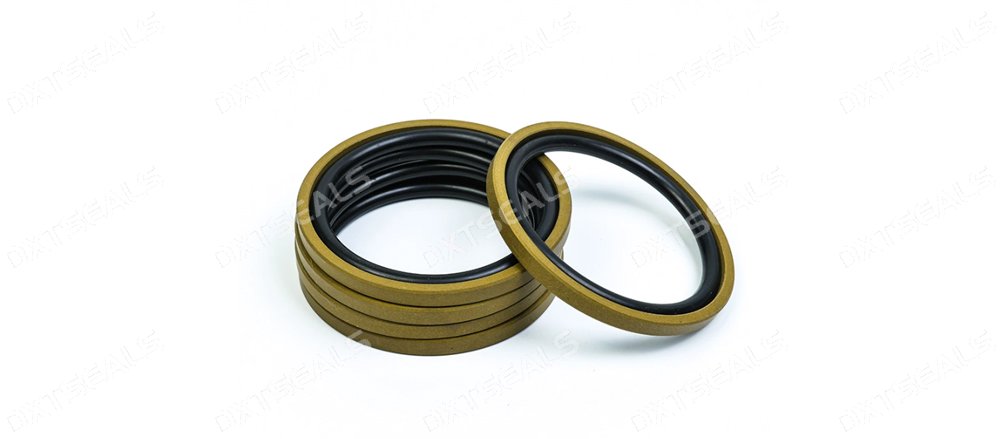
Glyd rings and Step Seals are widely used dynamic sealing products for hydraulic cylinders, pneumatic cylinders, industrial actuators, and other reciprocating equipment. Both designs commonly use a polymer sealing element combined with an elastomer energizer, providing a balance between low friction, sealing performance, and durability.
Although Glyd rings and Step Seals have similar basic structures, they are generally designed for different installation positions. Glyd rings are commonly used as piston seals, while Step Seals are commonly used as rod seals.
Understanding their structural features, material options, and operating characteristics is important when selecting the right sealing product.
What Is a Glyd Ring?
A Glyd ring is a dynamic sealing ring typically used on the piston of a hydraulic or pneumatic cylinder.
Its basic structure consists of:
- A PTFE or polymer sealing ring
- An elastomer O-ring energizer
The elastomer O-ring is installed behind the polymer sealing ring and provides the radial force required to maintain contact with the cylinder bore.
The polymer ring forms the main sliding sealing surface.
This combination allows the seal to combine the elasticity of an elastomer with the low-friction characteristics of PTFE or other engineered polymers.
Structural Features of Glyd Rings
The sealing ring normally has a specially designed profile that fits into the piston groove.
The main components perform different functions.
Polymer Sealing Ring
The polymer ring provides:
- Primary sealing
- Low friction
- Sliding performance
- Wear resistance
- Chemical resistance
PTFE is commonly selected, although other engineered polymers may also be used.
Elastomer Energizer
The O-ring provides the radial force that presses the sealing ring against the cylinder bore.
It helps maintain sealing contact when system pressure is low.
As pressure increases, the working medium can also contribute to the sealing force.
Advantages of Glyd Rings
Glyd rings are widely used because they provide several useful performance characteristics.
Low Friction
The PTFE sealing element has a low coefficient of friction, helping reduce resistance during piston movement.
Good Wear Resistance
Filled PTFE compounds can provide improved wear resistance for repeated reciprocating applications.
Good Chemical Resistance
PTFE offers excellent resistance to many hydraulic fluids and industrial chemicals, depending on the specific compound.
Smooth Movement
Low friction and appropriate seal geometry can help reduce stick-slip and improve cylinder movement.
Compact Design
Glyd rings can provide effective dynamic sealing without requiring a large installation space.
Typical Applications of Glyd Rings
Glyd rings are commonly used in:
- Hydraulic cylinders
- Pneumatic cylinders
- Industrial actuators
- Mobile hydraulic equipment
- Injection molding machines
- Machine tools
- Automation systems
They are especially suitable for piston sealing applications involving reciprocating movement.
What Is a Step Seal?
A Step Seal is a dynamic sealing element commonly used for rod sealing in hydraulic and pneumatic cylinders.
A typical Step Seal consists of:
- A PTFE or polymer sealing ring
- An elastomer energizer
The polymer element provides the primary sealing function, while the elastomer energizer maintains contact between the seal and the rod.
Step Seals are designed to accommodate reciprocating rod movement while controlling fluid leakage.
Structural Features of Step Seals
The polymer sealing ring generally has a stepped or profiled geometry designed to fit into the rod seal groove.
Its functions include:
- Sealing against the rod
- Reducing friction
- Resisting wear
- Maintaining dimensional stability
The elastomer energizer supports the polymer sealing ring and maintains contact during operation.
Advantages of Step Seals
Low Friction
PTFE-based sealing elements provide low sliding friction, which can reduce rod movement resistance.
Good Wear Resistance
Suitable PTFE compounds can provide good resistance to repeated reciprocating movement.
Good Pressure Performance
Depending on the profile, material, extrusion clearance, and operating conditions, Step Seals can be used in demanding hydraulic applications.
Compact Installation
Step Seals can provide effective rod sealing in relatively compact grooves.
Flexible Material Selection
Different polymer compounds and elastomer energizers can be selected according to the application.
Glyd Rings vs Step Seals
The most important distinction is their typical installation location.
| Feature | Glyd Rings | Step Seals |
|---|---|---|
| Typical Position | Piston | Rod |
| Main Function | Piston sealing | Rod sealing |
| Movement | Reciprocating | Reciprocating |
| Primary Material | PTFE/Polymer | PTFE/Polymer |
| Energizer | O-ring | Elastomer energizer |
| Friction | Low | Low |
| Wear Resistance | Good to Excellent | Good to Excellent |
| Hydraulic Applications | Yes | Yes |
| Pneumatic Applications | Yes | Yes |
The exact application should always be determined from the seal profile and manufacturer's technical specifications.
PTFE Materials for Glyd Rings and Step Seals
PTFE is one of the most common materials for these sealing products.
However, different PTFE formulations provide different performance characteristics.
Virgin PTFE
Virgin PTFE offers:
- Excellent chemical resistance
- Very low friction
- Good temperature resistance
- Good non-stick properties
It is suitable for applications where chemical resistance and low friction are the main priorities.
Glass-Filled PTFE
Glass-filled PTFE can provide improved:
- Wear resistance
- Compressive strength
- Dimensional stability
It can be suitable for applications involving higher mechanical loads.
Carbon-Filled PTFE
Carbon-filled PTFE can provide:
- Improved wear resistance
- Better mechanical strength
- Improved thermal conductivity
It is often considered for demanding dynamic applications.
Bronze-Filled PTFE
Bronze-filled PTFE can provide improved:
- Load-bearing capability
- Wear resistance
- Thermal conductivity
- Dimensional stability
The actual performance depends on the formulation and operating conditions.
Elastomer Energizer Materials
The elastomer energizer is an important part of both Glyd rings and Step Seals.
NBR
NBR is widely used because of its:
- Good oil resistance
- Good elasticity
- Good mechanical strength
- Cost effectiveness
It is suitable for many general hydraulic applications.
FKM
FKM provides good resistance to:
- High temperatures
- Oils
- Fuels
- Many chemicals
It is often selected for more demanding industrial applications.
EPDM
EPDM provides excellent resistance to:
- Water
- Steam
- Weathering
- Ozone
- Many chemicals
However, compatibility with petroleum-based hydraulic oils must be carefully considered.
How Material Selection Affects Seal Performance
The performance of a Glyd ring or Step Seal depends on the combination of the polymer sealing element and elastomer energizer.
Material selection affects:
- Friction
- Wear resistance
- Chemical compatibility
- Temperature resistance
- Pressure capability
- Service life
For example, a seal used in a high-temperature hydraulic system may require a different combination of PTFE compound and elastomer than a seal used in a standard pneumatic cylinder.
There is no single material combination that is ideal for every application.
Typical Hydraulic Applications
Glyd rings and Step Seals are widely used in hydraulic cylinders.
Construction Machinery
Hydraulic cylinders in excavators, loaders, cranes, and other heavy machinery operate under high loads and often face dust, dirt, vibration, and pressure fluctuations.
Durable piston and rod seals are essential for reliable operation.
Agricultural Machinery
Agricultural equipment operates in environments with dust, moisture, mud, and temperature changes.
Appropriate sealing systems help protect hydraulic cylinders and reduce fluid leakage.
Industrial Hydraulic Systems
Hydraulic presses, machine tools, injection molding equipment, and industrial actuators commonly use Glyd rings and Step Seals.
Typical Pneumatic Applications
Pneumatic cylinders generally operate at lower pressures but may run at higher cycle rates.
Low friction is therefore particularly important.
Glyd rings and Step Seals can be used in:
- Pneumatic cylinders
- Automation equipment
- Pick-and-place systems
- Factory machinery
- Pneumatic actuators
The seal material and profile should be selected according to air quality, speed, lubrication, temperature, and cylinder design.
How to Choose the Right Glyd Ring or Step Seal
Several operating parameters should be evaluated before selecting a seal.
1. Sealing Position
First determine whether the seal is installed on:
- The piston
- The rod
Glyd rings are generally associated with piston sealing, while Step Seals are commonly used for rod sealing.
2. Pressure
Consider:
- Normal operating pressure
- Maximum pressure
- Pressure spikes
- Pressure cycles
The seal profile and extrusion gap must be suitable for the pressure level.
3. Temperature
Evaluate the full temperature range, including:
- Minimum temperature
- Normal operating temperature
- Maximum continuous temperature
- Short-term temperature peaks
Both the polymer and elastomer materials must be compatible with the required temperature.
4. Working Medium
Typical media include:
- Hydraulic oil
- Water
- Air
- Water-glycol fluids
- Other industrial fluids
Material compatibility should be confirmed before selection.
5. Movement Speed
Reciprocating speed has a direct effect on friction and heat generation.
High-speed applications may require specially formulated PTFE compounds and optimized seal profiles.
6. Groove Dimensions
Important installation dimensions include:
- Rod diameter
- Bore diameter
- Groove diameter
- Groove width
- Groove depth
- Installation clearance
Correct groove dimensions are essential for proper sealing performance.
7. Surface Finish
The surface finish of the mating rod or cylinder bore can significantly affect seal life.
An excessively rough surface may accelerate wear, while an unsuitable surface condition can result in leakage or excessive friction.
Standard and Custom Glyd Rings and Step Seals
Standard Glyd rings and Step Seals are available in many commonly used dimensions.
Standard products offer several advantages:
- Easy replacement
- Lower production cost
- Established installation dimensions
- Shorter procurement cycles
- Wide equipment compatibility
However, some applications require non-standard dimensions or special materials.
Custom sealing products can be manufactured according to:
- Technical drawings
- CAD files
- Physical samples
- OEM specifications
- Customer requirements
Custom manufacturing can include modified dimensions, special PTFE compounds, alternative energizers, and customized sealing profiles.
Precision Manufacturing of PTFE Sealing Rings
PTFE sealing rings require controlled manufacturing processes to achieve consistent dimensions and sealing geometry.
Precision CNC machining can be used for:
- Custom Glyd rings
- Custom Step Seals
- PTFE piston seals
- PTFE rod seals
- Special sealing profiles
Important manufacturing parameters include:
- Seal diameter
- Cross-section
- Lip geometry
- Groove compatibility
- Surface finish
- Dimensional tolerance
For small batches or non-standard sealing profiles, precision machining can provide greater flexibility than dedicated tooling.
Conclusion
Glyd rings and Step Seals are important standard sealing products for hydraulic and pneumatic equipment.
Glyd rings are primarily used for piston sealing, combining a PTFE or polymer sealing ring with an elastomer O-ring energizer. Their low friction, wear resistance, and chemical resistance make them suitable for many reciprocating applications.
Step Seals are commonly used for rod sealing, providing low-friction dynamic sealing in hydraulic and pneumatic cylinders.
PTFE compounds such as virgin PTFE, glass-filled PTFE, carbon-filled PTFE, and bronze-filled PTFE can be selected according to the required wear resistance, mechanical strength, friction, and dimensional stability. NBR, FKM, and EPDM are commonly considered for the elastomer energizer depending on the working medium and temperature.
For standard applications, standard-size Glyd rings and Step Seals provide a convenient and cost-effective sealing solution. For special equipment, manufacturers with precision PTFE machining capabilities can also produce custom sealing rings according to drawings, samples, and OEM requirements.