
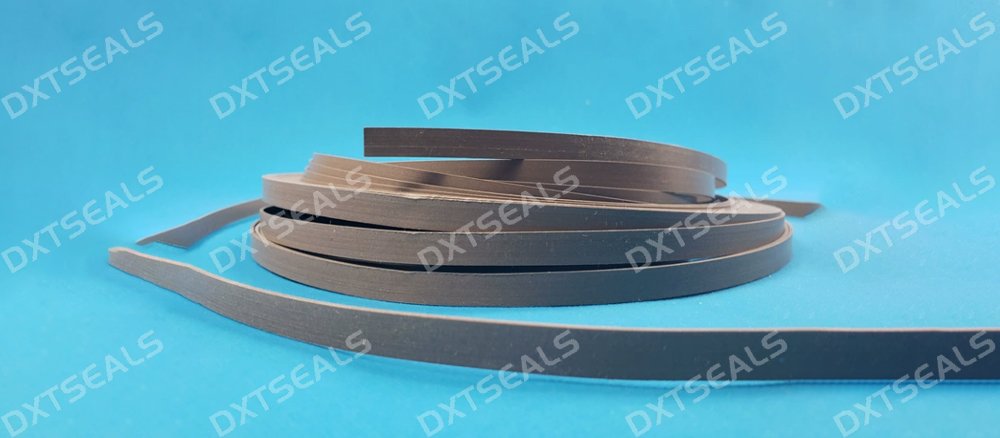
PTFE guide strips are widely used in hydraulic cylinders, pneumatic cylinders, and other reciprocating equipment to guide moving components and prevent metal-to-metal contact. They can reduce friction, absorb radial loads, protect cylinder surfaces, and extend the service life of sealing components.
However, not every PTFE guide strip is suitable for every application. The correct material, size, profile, and design must be selected according to the equipment's operating conditions.
This guide explains the most important factors to consider when choosing a PTFE guide strip for hydraulic and pneumatic equipment.
What Is a PTFE Guide Strip?
A PTFE guide strip, also known as a PTFE guide band or wear strip, is a guiding component installed in a groove on a piston or piston rod.
Its main functions are to:
- Guide the piston or rod during movement
- Absorb radial and side loads
- Prevent metal-to-metal contact
- Reduce friction and wear
- Protect cylinder surfaces
- Reduce stress on hydraulic seals
Unlike a hydraulic seal, a guide strip is not primarily designed to prevent fluid leakage. Instead, it provides mechanical guidance and load support.
1. Select the Right PTFE Material
Material selection is one of the most important factors when choosing a guide strip.
Virgin PTFE
Virgin PTFE provides very low friction and excellent chemical resistance.
It is suitable for:
- Light-load applications
- Low-friction requirements
- Corrosive environments
- General pneumatic equipment
However, pure PTFE has lower mechanical strength than filled PTFE and may not be suitable for heavy side loads.
Bronze-Filled PTFE
Bronze-filled PTFE is one of the most commonly used materials for hydraulic guide strips.
Bronze reinforcement improves:
- Load-bearing capacity
- Wear resistance
- Compressive strength
- Thermal conductivity
- Dimensional stability
It is particularly suitable for hydraulic cylinders and heavy-duty industrial equipment.
Carbon-Filled PTFE
Carbon-filled PTFE provides improved wear resistance and mechanical performance while maintaining good sliding characteristics.
It can be considered for:
- High-speed applications
- Heavy-duty equipment
- Applications requiring improved thermal performance
Glass-Filled PTFE
Glass fiber reinforcement improves rigidity and dimensional stability.
It may be suitable when:
- Higher compressive strength is required.
- Dimensional stability is important.
- The application involves moderate to high mechanical loads.
The correct filler and formulation should be selected according to the actual operating conditions.
2. Consider the Radial Load
The guide strip must be capable of supporting the side load generated during equipment operation.
Hydraulic cylinders used in construction machinery, presses, and heavy equipment can experience significant lateral forces.
When selecting a guide strip, consider:
- Maximum radial load
- Load distribution
- Piston diameter
- Rod diameter
- Cylinder alignment
- Operating pressure
For higher loads, filled PTFE materials such as bronze-filled PTFE are generally more suitable than virgin PTFE.
3. Check the Operating Speed
Reciprocating speed affects friction, heat generation, and wear.
A guide strip used in a slow-moving hydraulic cylinder may have different material requirements from one used in a high-speed pneumatic cylinder.
High-speed applications require careful consideration of:
- Friction
- Heat generation
- Material wear
- Surface finish
- Lubrication
PTFE is naturally advantageous for sliding applications because of its low coefficient of friction, but the specific filled grade should still be selected according to the application.
4. Consider Operating Temperature
Temperature can significantly affect guide strip performance.
PTFE has a wide usable temperature range, but filled PTFE compounds may have different mechanical characteristics at elevated temperatures.
When selecting a guide strip, consider:
- Minimum operating temperature
- Maximum continuous temperature
- Temperature fluctuations
- Heat generated by friction
- Surrounding environmental temperature
For high-temperature equipment, the selected PTFE compound should be verified against the actual operating conditions.
5. Check Hydraulic or Pneumatic Media Compatibility
PTFE provides excellent chemical resistance and is compatible with many industrial fluids.
However, the complete guide strip material should be evaluated rather than considering only the PTFE base material.
Important factors include:
- Hydraulic oil
- Water-based hydraulic fluids
- Lubricants
- Cleaning agents
- Chemicals
- Pneumatic media
The filler material and operating environment should also be considered when selecting a specific PTFE compound.
6. Select the Correct Dimensions
Correct dimensions are essential for reliable installation and guiding performance.
Important dimensions include:
- Inner diameter
- Outer diameter
- Width
- Thickness
- Groove width
- Groove depth
- Clearance
An incorrectly sized guide strip can result in:
- Excessive movement
- Poor load distribution
- Increased friction
- Premature wear
- Installation difficulties
For OEM replacement or custom applications, manufacturers can produce guide strips according to technical drawings or sample components.
7. Consider the Groove Design
The guide strip must be compatible with the piston or rod groove.
Before ordering, check:
- Groove diameter
- Groove width
- Groove depth
- Chamfer dimensions
- Corner radius
- Installation clearance
The groove design determines the appropriate guide strip dimensions and installation method.
8. Consider Surface Finish
The mating surface has a direct impact on guide strip performance.
A properly finished cylinder bore or rod surface helps reduce friction and wear.
When selecting a PTFE guide strip, consider:
- Surface roughness
- Surface hardness
- Roundness
- Straightness
- Alignment
A high-quality guide strip cannot compensate for a severely damaged or improperly finished mating surface.
9. Choose the Right Guide Strip Profile
Different hydraulic and pneumatic systems may require different guide strip designs.
Common forms include:
- Flat guide strips
- Split guide rings
- Continuous guide bands
- Custom-machined guide rings
For some applications, guide strips are supplied in rolls and cut to the required length. For others, precision-machined rings are more suitable.
The profile should match the equipment groove and installation requirements.
PTFE Guide Strip Selection for Hydraulic Cylinders
Hydraulic cylinders generally experience higher loads and pressures than many pneumatic systems.
For hydraulic applications, the following factors are especially important:
- High radial load capacity
- Wear resistance
- Pressure environment
- Hydraulic fluid compatibility
- Operating temperature
- Reciprocating speed
Bronze-filled PTFE is often selected for demanding hydraulic cylinder applications because it provides a good balance of low friction, wear resistance, and mechanical strength.
PTFE Guide Strip Selection for Pneumatic Systems
Pneumatic cylinders generally emphasize smooth movement, low friction, and high cycling frequency.
Important considerations include:
- Low friction
- High-speed performance
- Dimensional stability
- Air compatibility
- Wear resistance
- Installation accuracy
Virgin PTFE or selected filled PTFE materials can be used depending on load and operating requirements.
Common Selection Mistakes
Several mistakes can reduce guide strip service life.
Choosing Only by Size
A guide strip that fits dimensionally may still be unsuitable for the operating load, speed, or temperature.
Using Virgin PTFE for Heavy Loads
Pure PTFE offers excellent sliding properties but may deform under high loads. Filled PTFE is often more appropriate for heavy-duty applications.
Ignoring Operating Speed
High-speed reciprocating movement can generate heat and accelerate wear if the material is not properly selected.
Ignoring the Mating Surface
Poor cylinder surface quality can increase friction and wear regardless of guide strip material.
Using the Wrong Groove Dimensions
Incorrect groove dimensions can prevent the guide strip from functioning correctly and may lead to premature failure.
Custom PTFE Guide Strip Manufacturing
Standard guide strips are suitable for many applications, but custom dimensions may be required for specialized hydraulic and pneumatic equipment.
Custom manufacturing can include:
- Custom widths
- Custom thicknesses
- Non-standard diameters
- Special PTFE compounds
- Custom guide profiles
- OEM production
- Production according to drawings
- Sample-based manufacturing
Precision machining allows manufacturers to produce guide strips for both standard and non-standard equipment.
PTFE Guide Strip Selection Checklist
Before selecting a guide strip, confirm the following:
- Application: hydraulic or pneumatic
- Piston or rod diameter
- Groove dimensions
- Maximum radial load
- Operating speed
- Operating temperature
- Working medium
- Required wear resistance
- Surface finish
- Required service life
- Material compatibility
Providing these details to the manufacturer makes it easier to select the correct material and dimensions.
Conclusion
Choosing the right PTFE guide strip requires more than simply matching the installation dimensions. Material grade, radial load, operating speed, temperature, fluid compatibility, groove design, surface finish, and application conditions all affect guide strip performance.
For general low-load applications, virgin PTFE can provide excellent low-friction performance. For hydraulic cylinders and heavy-duty equipment, bronze-filled PTFE or other reinforced PTFE compounds can provide improved wear resistance, load capacity, and dimensional stability.
By selecting the correct PTFE material and guide strip dimensions for the actual operating conditions, manufacturers and equipment users can reduce friction, protect cylinder surfaces, extend seal life, and improve the overall reliability of hydraulic and pneumatic systems.