
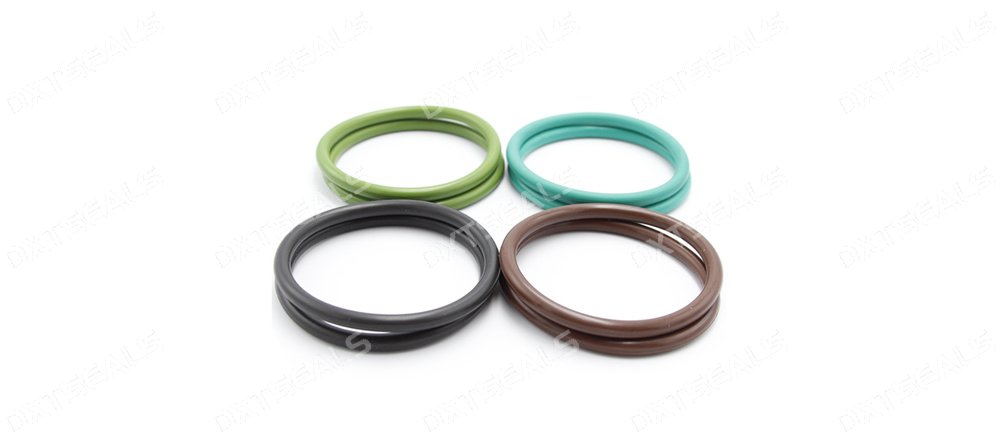
O-rings are among the most widely used sealing components in industrial equipment. Their simple circular design allows them to provide reliable sealing in hydraulic systems, pneumatic equipment, pumps, valves, automotive components, and general machinery.
Among the many available O-ring materials, NBR and FKM are two of the most commonly considered options for applications involving oils, fuels, hydraulic fluids, and industrial chemicals.
NBR, also known as nitrile rubber, is widely used because it offers a good balance of mechanical properties, oil resistance, wear resistance, and cost. FKM, a fluoroelastomer family, is commonly selected when higher temperature resistance, improved resistance to many fuels and chemicals, and long-term performance in demanding environments are required.
However, FKM is not automatically a replacement for NBR. Each material has advantages and limitations, and the appropriate choice depends on the actual operating conditions.
What Is an NBR O-Ring?
NBR stands for nitrile butadiene rubber. It is a widely used synthetic elastomer for O-rings and other sealing products.
NBR provides a useful combination of:
- Oil resistance
- Mechanical strength
- Abrasion resistance
- Elasticity
- Compression resistance
- Cost-effectiveness
Because of these characteristics, NBR is frequently used in hydraulic, pneumatic, automotive, and general industrial sealing applications.
Advantages of NBR O-Rings
NBR offers several practical advantages:
- Good resistance to petroleum-based oils
- Good compatibility with many hydraulic fluids
- Good abrasion resistance
- Good mechanical strength
- Good flexibility
- Good sealing performance in general industrial applications
- Wide availability in standard O-ring sizes
- Cost-effective for many applications
NBR is often a practical choice when operating conditions are moderate and the process medium is compatible with nitrile rubber.
Limitations of NBR O-Rings
NBR also has limitations.
Compared with FKM, conventional NBR generally has lower resistance to high temperatures, ozone, weathering, and certain aggressive chemicals.
NBR may also have limited suitability for:
- Long-term outdoor exposure
- High-temperature oil service
- Certain aggressive chemicals
- Some fuels and specialized fluids
- Environments requiring exceptional aging resistance
The actual performance depends on the specific NBR compound and operating conditions.
What Is an FKM O-Ring?
FKM refers to a family of fluoroelastomers used for high-performance sealing applications.
FKM O-rings are commonly selected when the application requires a combination of elevated-temperature capability, resistance to many oils and fuels, chemical resistance, and good aging performance.
Advantages of FKM O-Rings
Typical advantages include:
- Good high-temperature performance
- Excellent resistance to many petroleum-based oils
- Good fuel resistance
- Good resistance to many chemicals
- Excellent resistance to ozone and weathering
- Good aging resistance
- Good compression-set resistance at elevated temperatures for suitable grades
- Good performance in demanding industrial environments
FKM is therefore frequently used when the service conditions exceed the practical range of general-purpose NBR.
Limitations of FKM O-Rings
FKM also has limitations.
Compared with NBR, FKM is generally more expensive. It may also be less suitable for certain low-temperature applications, and its chemical resistance is not universal.
Certain chemicals, especially some amines, ketones, low-molecular-weight esters, and other specific chemical environments, can present compatibility concerns depending on the FKM formulation.
Therefore, the exact FKM grade should be selected according to the actual medium and operating conditions.
NBR vs FKM: Key Differences
The following table provides a general comparison.
| Property | NBR O-Ring | FKM O-Ring |
|---|---|---|
| Material type | Nitrile rubber | Fluoroelastomer |
| Oil resistance | Good to excellent | Excellent |
| Fuel resistance | Good for many applications | Excellent for many fuels |
| High-temperature performance | Good | Excellent |
| Low-temperature flexibility | Generally good | More grade-dependent |
| Chemical resistance | Good | Very good to excellent for many chemicals |
| Ozone resistance | Moderate | Excellent |
| Weather resistance | Moderate | Excellent |
| Abrasion resistance | Good | Good |
| Mechanical strength | Good | Good |
| Compression-set resistance | Good | Very good, especially at elevated temperatures |
| Cost | Generally lower | Generally higher |
| Typical applications | Hydraulic, pneumatic, oil systems | High-temperature, fuel, chemical, demanding industrial systems |
This comparison is a general guide. Actual performance depends on the compound formulation, hardness, temperature, pressure, medium, and sealing design.
NBR vs FKM for Oil and Hydraulic Applications
Both NBR and FKM can be used with many oil-based fluids, but the appropriate choice depends on the operating conditions.
When NBR May Be Suitable
NBR is commonly selected for:
- General hydraulic systems
- Pneumatic equipment
- Industrial machinery
- Hydraulic cylinders
- Pumps
- Valves
- Oil-lubricated equipment
When temperatures and fluid conditions are within the practical range of the NBR compound, NBR can provide reliable performance without the additional material cost of FKM.
When FKM May Be Preferred
FKM may be considered when the application involves:
- Higher operating temperatures
- Fuel exposure
- Petroleum-based fluids at elevated temperatures
- More demanding chemical environments
- Long-term exposure to ozone or weather
- Greater requirements for aging resistance
The final selection should be based on the actual fluid and temperature rather than simply choosing FKM because it is a higher-performance material.
NBR vs FKM Temperature Performance
Temperature is one of the most important differences between NBR and FKM.
NBR performs well across many general industrial applications, but its long-term temperature capability is generally lower than that of FKM.
FKM is commonly selected for applications involving higher temperatures, particularly when the seal is simultaneously exposed to oils, fuels, or other demanding fluids.
However, temperature ratings are not universal. They depend on:
- Material formulation
- O-ring hardness
- Operating pressure
- Process medium
- Exposure time
- Dynamic movement
- Compression
- Seal design
A manufacturer's technical data should be checked before assigning a specific operating temperature to an O-ring.
NBR vs FKM Chemical Resistance
Chemical compatibility is another important difference.
NBR Chemical Resistance
NBR generally provides good resistance to many petroleum-based oils and hydraulic fluids. However, its compatibility with chemicals, fuels, and solvents varies considerably.
NBR should not be selected solely because a fluid is classified as an industrial oil. The exact fluid composition and temperature should be evaluated.
FKM Chemical Resistance
FKM provides excellent resistance to many oils, fuels, and industrial chemicals.
However, FKM is not chemically universal. Some chemical groups can cause swelling, degradation, or loss of mechanical properties depending on the FKM formulation.
For specialized chemical applications, the exact FKM grade should be confirmed against the actual medium, concentration, temperature, and exposure time.
NBR vs FKM for Dynamic Sealing
O-rings can be used in certain dynamic applications, including reciprocating and rotary sealing.
For dynamic applications, material selection must consider more than chemical compatibility.
Important factors include:
- Friction
- Wear
- Shaft or bore surface finish
- Operating speed
- Pressure
- Lubrication
- Groove dimensions
- Clearance
- Temperature
NBR can provide good mechanical and wear properties for many general dynamic applications.
FKM can be advantageous when dynamic sealing is combined with elevated temperatures or demanding chemical and fluid conditions.
For high-speed or highly specialized dynamic applications, however, a dedicated seal profile may be more appropriate than a conventional O-ring.
NBR vs FKM for Outdoor Applications
Environmental exposure can influence O-ring service life.
NBR has useful general-purpose performance but has lower resistance to ozone and weathering than FKM.
FKM generally provides better resistance to:
- Ozone
- UV exposure
- Weathering
- Aging
- Elevated-temperature environmental exposure
For outdoor equipment that is also exposed to oils or fuels, FKM may be considered when the operating conditions justify its higher material cost.
NBR vs FKM Cost
Cost is another practical consideration.
NBR is generally less expensive than FKM and is widely available in standard sizes. This makes NBR attractive for high-volume industrial applications where the operating conditions do not require the additional performance of FKM.
FKM generally has a higher material cost, but it may provide longer service life or improved reliability in applications involving high temperature, fuels, oils, or demanding environmental conditions.
The lowest material price is not necessarily the lowest total cost. Seal replacement frequency, maintenance downtime, equipment accessibility, and failure consequences should also be considered.
How to Choose Between NBR and FKM O-Rings
A systematic selection process can help identify the appropriate material.
1. Identify the Sealing Medium
Determine exactly what the O-ring will contact.
Consider:
- Hydraulic oil
- Mineral oil
- Fuel
- Water
- Air
- Steam
- Chemical solutions
- Solvents
- Refrigerants
- Process fluids
Material compatibility should be checked against the actual fluid rather than relying only on a broad fluid category.
2. Check the Operating Temperature
Determine both the normal operating temperature and possible temperature peaks.
If the application involves elevated temperatures for long periods, FKM may offer advantages over conventional NBR.
3. Check Operating Pressure
Pressure affects O-ring deformation and extrusion risk.
Consider:
- Maximum system pressure
- Pressure fluctuations
- Clearance gap
- O-ring hardness
- Groove design
- Backup ring requirements
A material choice alone cannot solve an unsuitable groove or excessive extrusion gap.
4. Determine Static or Dynamic Sealing
Static and dynamic applications have different requirements.
For static applications, compression and chemical compatibility are particularly important.
For dynamic applications, friction, wear, lubrication, surface finish, and operating speed must also be evaluated.
5. Consider Environmental Exposure
Check whether the O-ring will be exposed to:
- Ozone
- UV radiation
- Outdoor weather
- Humidity
- High temperature
- Low temperature
- Dust
- Cleaning chemicals
FKM generally offers better ozone and weathering resistance than conventional NBR.
6. Evaluate Required Service Life
If an O-ring is difficult to access or replacement requires significant equipment downtime, long-term material stability may justify selecting a higher-performance material.
However, material selection should still be based on actual operating requirements rather than assuming that a more expensive material is always better.
NBR or FKM: Typical Application Examples
| Application | Common Material Consideration |
|---|---|
| General hydraulic equipment | NBR |
| Pneumatic equipment | NBR |
| General oil sealing | NBR |
| High-temperature oil system | FKM |
| Fuel system | NBR or FKM depending on fuel and conditions |
| High-temperature valve | FKM |
| Outdoor oil-exposed equipment | FKM |
| General industrial machinery | NBR |
| Chemical equipment | FKM or specialized material depending on chemical |
| High-temperature pump | FKM or specialized material |
These are general examples rather than universal material recommendations. The exact fluid, temperature, pressure, and equipment design should always be evaluated.
NBR and FKM O-Ring Hardness
Material selection and hardness selection should be considered together.
O-ring hardness is commonly specified using the Shore A scale.
A softer O-ring can conform well to surface irregularities and may provide effective sealing at lower contact pressure. A harder O-ring may offer greater resistance to extrusion under suitable conditions.
The appropriate hardness depends on:
- System pressure
- Groove design
- Clearance
- Static or dynamic sealing
- Temperature
- Material compound
- Installation conditions
Choosing NBR or FKM without considering hardness may result in a less-than-optimal sealing configuration.
O-Ring Groove and Installation Considerations
Even a correctly selected material can fail if the O-ring is improperly installed.
Important factors include:
- Correct groove dimensions
- Proper compression
- Suitable stretch
- Appropriate clearance
- Surface finish
- Installation chamfers
- Lubrication
- Prevention of twisting
- Avoidance of cuts and scratches
For dynamic applications, shaft and bore surface conditions are particularly important.
In high-pressure applications, backup rings may also be required to reduce extrusion risk.
When Should You Choose NBR?
NBR is often a practical choice when:
- The application involves compatible oils or hydraulic fluids
- Operating temperatures are moderate
- Good mechanical strength is required
- Abrasion resistance is important
- The application is cost-sensitive
- Standard industrial sealing performance is sufficient
NBR can provide an effective balance between performance and cost for a wide range of industrial equipment.
When Should You Choose FKM?
FKM may be considered when:
- Operating temperatures are relatively high
- The seal contacts fuels or oils
- Better ozone and weather resistance is required
- Long-term aging resistance is important
- The application involves demanding industrial fluids
- The additional material cost is justified by operating requirements
FKM should still be checked for compatibility with the exact process medium.
Common Mistakes When Choosing NBR or FKM
Choosing FKM Simply Because It Is a Higher-Performance Material
Higher material performance does not mean universal compatibility. The actual application should determine the material.
Choosing NBR Only Because It Is Less Expensive
A lower initial price may not be beneficial if the application requires higher temperature or environmental resistance.
Ignoring the Process Medium
Oil, fuel, chemical, and hydraulic-fluid compatibility can vary significantly between different formulations.
Selecting Only by Temperature
Temperature, pressure, medium, movement, and installation conditions all influence O-ring performance.
Ignoring O-Ring Hardness and Groove Design
The material alone does not determine sealing performance. Hardness, compression, clearance, and groove geometry are equally important.
Custom NBR and FKM O-Ring Manufacturing
Standard O-ring sizes cover many industrial applications, but specialized equipment may require non-standard dimensions or specific material compounds.
Custom NBR and FKM O-rings can be manufactured according to:
- Engineering drawings
- Customer samples
- Equipment dimensions
- OEM specifications
- Non-standard cross-sections
- Specific hardness requirements
- Special operating conditions
For replacement applications, custom O-rings can also be produced based on existing components when standard sizes are not suitable.
Conclusion
NBR and FKM are both important O-ring materials, but they are designed to address different operating requirements.
NBR O-rings provide a practical combination of oil resistance, mechanical strength, wear resistance, flexibility, and cost-effectiveness. They are widely used in hydraulic systems, pneumatic equipment, pumps, valves, and general industrial machinery.
FKM O-rings are commonly selected when higher temperature performance, resistance to many oils and fuels, improved ozone resistance, and demanding environmental performance are required.
The right choice between NBR and FKM should be based on the sealing medium, temperature, pressure, static or dynamic operation, environmental exposure, hardness, groove design, and required service life.
A professional sealing manufacturer can provide both standard and custom NBR and FKM O-rings, helping match the material, dimensions, hardness, and sealing design to the specific industrial application.