
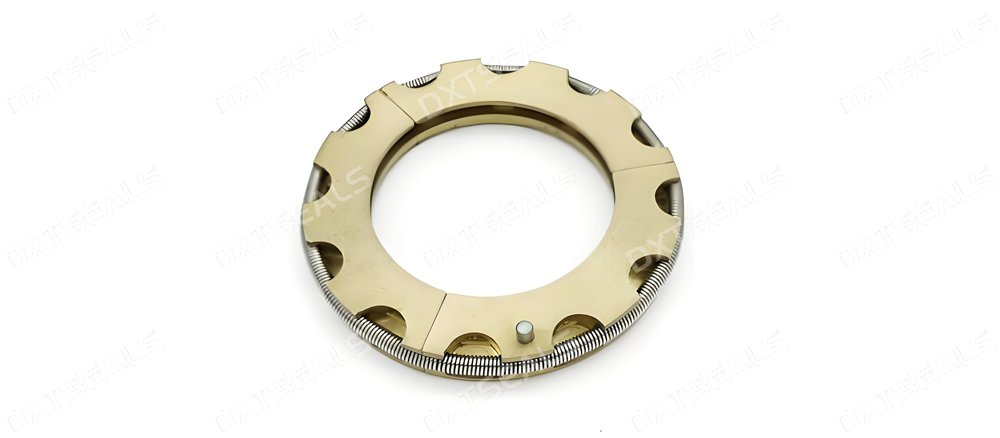
Oil scraper rings (also known as oil control rings or wiper rings) are critical components in air compressors, engines, and rotating machinery. Their main function is to remove excess oil from the shaft surface and ensure that lubricants remain only at the designated lubrication zone—preventing oil from entering the compression chamber or leaking externally.
Incorrect installation direction or improper clearance control can lead to:
-
Excessive oil consumption
-
Oil leakage into the compression area
-
Reduced sealing performance
-
Premature wear or failure of the sealing system
To help users avoid these issues, DXTSEALS provides a detailed guide on installation direction and proper gap control.
1️⃣ Understanding the Function of Oil Scraper Rings
An oil scraper ring works by wiping lubricant from the rotating shaft and directing excess oil back into the lubrication system. It is commonly used in:
-
Air compressors
-
Piston compressors
-
Pumps
-
Mechanical equipment with lubrication circulation systems
The ring must maintain a balance between:
-
Removing excess oil
-
Allowing enough oil lubrication to minimize wear
2️⃣ Oil Scraper Ring Installation Direction
✔ One side is designed to scrape oil; the other side allows oil return.
Oil scraper rings typically have an angled or chamfered edge.
Here’s how to determine the direction:
| Feature | Direction Facing the Oil Source | Direction Facing Outside |
|---|---|---|
| Chamfer / Beveled edge | ✅ Yes (facing lubricant side) | ❌ No |
| Flat surface | ❌ No | ✅ Yes (toward dry area / compression chamber / external side) |
🔧 Installation Rule:
Chamfered side ➝ Oil side
Flat side ➝ Dry / sealing side
If installed in reverse, oil is pushed outward instead of back into the lubrication zone, causing serious oil leakage.
3️⃣ Clearance Control — Critical for Proper Sealing
The oil scraper ring must have precise radial and axial clearance to function correctly.
🛠 Radial Clearance (between ring and shaft)
-
Too small → increased friction, overheating, wear
-
Too large → insufficient oil control, leakage risk
✅ Recommended guideline (typical range):
0.05–0.15 mm (depending on shaft diameter and material)
🛠 Axial Clearance (ring-to-groove side clearance)
-
Allows ring to move slightly during operation
-
Prevents sticking and uneven wear
✅ Recommended guideline:
0.10–0.25 mm
🧪 End Gap (ring gap)
-
Must allow thermal expansion
-
Too small → ring deformation, breakage
-
Too large → leakage increases
✅ Typical value:
0.20–0.40 mm
DXTSEALS engineers recommend measuring clearance using feeler gauge during installation.
4️⃣ Key Installation Steps
-
Clean the shaft surface and remove burrs or rust.
-
Check shaft surface roughness (< Ra 0.4 μm for best performance).
-
Verify installation direction (chamfer ➝ lubrication side).
-
Measure and ensure end gap and clearance.
-
Apply thin film of lubricant to avoid dry contact during startup.
5️⃣ Common Installation Errors (and how to avoid them)
| Mistake | Effect | Prevention |
|---|---|---|
| Installing direction reversed | Oil is pushed outward → leakage | Ensure chamfer is toward oil source |
| Clearance too tight | Overheating, wear | Measure with feeler gauge |
| Clearance too large | Inefficient oil control | Confirm groove accuracy |
| Dry installation | Instant wear at startup | Apply thin layer of oil |
✅ Conclusion
Proper installation direction and clearance control directly determine the sealing performance and service life of an oil scraper ring. By ensuring:
-
Chamfer faces the oil source
-
End gap and clearance are within specification
You can significantly reduce oil leakage and improve operating reliability.
DXTSEALS provides custom-made oil scraper rings with materials including PTFE, POM, bronze-filled PTFE, and stainless steel, suitable for air compressors, hydraulic systems, and high-speed rotating equipment.
📩 Need customized scraper rings?
Contact DXTSEALS for:
-
Engineering consultation
-
Material selection guidance
-
Custom production based on drawings / samples
Reliable sealing begins with the right material and correct installation.