
1. Introduction
PTFE flange gaskets are widely used in industrial piping systems where chemical resistance, low friction, and reliable sealing are essential. Manufactured from polytetrafluoroethylene (PTFE), these gaskets are suitable for many applications involving corrosive chemicals, aggressive process media, and fluids that may be incompatible with conventional rubber materials.
PTFE is valued for its broad chemical resistance, low moisture absorption, and non-stick surface. It is commonly used in chemical processing plants, pharmaceutical equipment, water treatment facilities, industrial pipelines, and other applications requiring chemically resistant sealing components.
However, PTFE flange gaskets have specific mechanical characteristics that must be considered during selection. Compared with elastic rubber materials, PTFE has limited recovery after deformation and may experience creep or cold flow under sustained compressive loading. These characteristics can affect sealing performance if the gasket design and installation conditions are unsuitable.
This guide explains the chemical resistance, sealing performance, material types, industrial applications, and selection considerations for PTFE flange gaskets.
2. What Is a PTFE Flange Gasket?
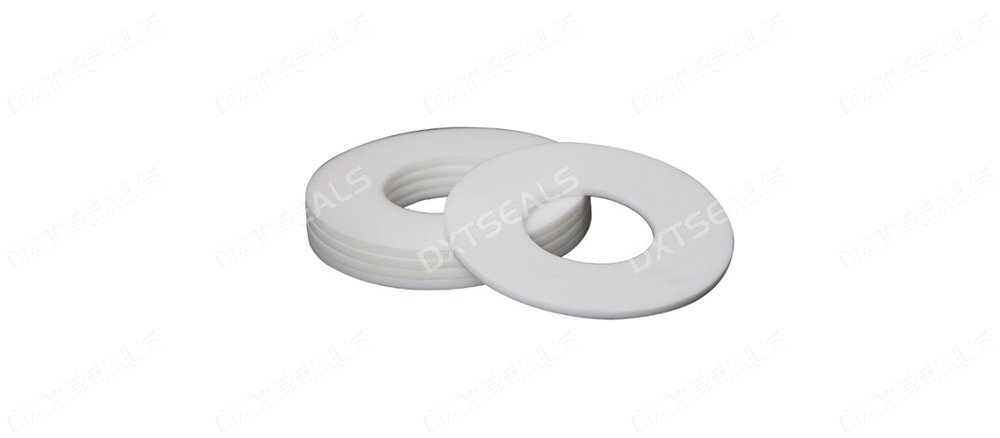
A PTFE flange gasket is a flat sealing component installed between two mating flanges. When the flange bolts are tightened, the gasket compresses against the sealing surfaces to help prevent fluid or gas leakage.
PTFE is a synthetic fluoropolymer known for its chemical inertness and low coefficient of friction. Unlike elastomeric materials such as EPDM and NBR, standard PTFE is not highly elastic and does not recover in the same way after compression.
PTFE flange gaskets are available in various configurations, including:
-
Virgin PTFE flange gaskets.
-
Modified PTFE flange gaskets.
-
Expanded PTFE (ePTFE) flange gaskets.
-
Filled PTFE gaskets.
-
Custom-cut PTFE gaskets manufactured to drawings or samples.
The appropriate type depends on the chemical medium, temperature, pressure, flange condition, and required sealing performance.
3. Chemical Resistance of PTFE Flange Gaskets
One of the main advantages of PTFE flange gaskets is their resistance to a broad range of chemicals. PTFE is suitable for many corrosive environments where conventional rubber or fiber-based gasket materials may not provide adequate compatibility.
3.1 Resistance to Acids
PTFE is compatible with many strong inorganic and organic acids under a wide range of conditions. This makes PTFE gaskets useful in chemical processing equipment, acid-handling pipelines, and industrial fluid transfer systems.
The suitability of a gasket must still be verified for the exact acid, concentration, temperature, and operating conditions.
3.2 Resistance to Alkalis
PTFE generally offers excellent resistance to many alkaline solutions. It is therefore considered for equipment handling compatible caustic and alkaline media.
For concentrated solutions or elevated-temperature applications, confirm the complete operating specification before selecting the gasket.
3.3 Resistance to Solvents
PTFE is resistant to many industrial solvents and is often used in chemical processing environments where solvent compatibility is important.
Nevertheless, compatibility should not be assumed for every process mixture or operating condition. Check the manufacturer's chemical compatibility data for the actual medium.
3.4 Resistance to Oils and Hydrocarbons
PTFE has broad compatibility with many oils and hydrocarbon-based fluids. It may be suitable for applications where the chemical resistance of conventional elastomeric gaskets is insufficient.
The suitability of the complete gasket assembly should be assessed when additives, mixtures, elevated temperatures, or special operating conditions are involved.
3.5 Chemical Resistance Limitations
Although PTFE has excellent chemical resistance, no gasket should be selected based on the material name alone.
Consider the following factors:
-
Chemical identity and concentration.
-
Operating temperature.
-
Pressure and mechanical loading.
-
Gasket construction and thickness.
-
Flange surface condition.
-
Possible interactions involving fillers or reinforcement materials.
For demanding chemical service, verify the exact PTFE formulation and the manufacturer's recommendations.
4. Types of PTFE Flange Gaskets
Different PTFE gasket constructions provide different levels of compressibility, dimensional stability, and resistance to deformation.
4.1 Virgin PTFE Gaskets
Virgin PTFE gaskets are manufactured from PTFE without intentionally added fillers. They offer broad chemical resistance and low moisture absorption.
Advantages:
-
Excellent resistance to many chemicals.
-
Low friction and non-stick properties.
-
Low moisture absorption.
-
Suitable for many clean chemical applications.
Considerations:
Virgin PTFE can deform under sustained compressive stress. Flange loading, gasket dimensions, temperature, and pressure must be evaluated to minimize leakage risk.
4.2 Modified PTFE Gaskets
Modified PTFE uses a modified polymer formulation designed to improve certain sealing characteristics compared with conventional virgin PTFE.
Depending on the grade, it may offer improved creep resistance, better sealing conformity, or reduced permeability.
Advantages:
-
Improved resistance to deformation in suitable formulations.
-
Good chemical resistance.
-
Potentially improved sealing reliability in demanding flange connections.
Considerations:
Properties vary by manufacturer and formulation. Confirm chemical compatibility and performance data for the exact grade.
4.3 Expanded PTFE Gaskets
Expanded PTFE is produced by expanding PTFE into a more compressible structure. This construction can conform more readily to irregular flange surfaces and is commonly used in applications where sealing conformity is important.
Advantages:
-
High compressibility.
-
Good conformity to uneven or irregular surfaces.
-
Broad chemical resistance.
-
Available in sheet, tape, and other gasket forms.
Considerations:
The appropriate grade, thickness, and compression requirements depend on the flange design and operating conditions. Excessive compression must be avoided.
4.4 Filled PTFE Gaskets
Filled PTFE incorporates selected fillers to modify mechanical or thermal properties. Depending on the formulation, fillers may improve stiffness, wear resistance, or resistance to deformation.
Advantages:
-
Tailored mechanical properties.
-
Potentially improved dimensional stability.
-
Options for specialized industrial applications.
Considerations:
Fillers can change chemical compatibility. Filled PTFE should not automatically be treated as chemically equivalent to virgin PTFE.
5. PTFE Flange Gasket Sealing Performance
Chemical resistance is only one part of gasket performance. A PTFE flange gasket must also maintain adequate sealing contact under compression and operating loads.
5.1 Sealing Under Compression
When a PTFE gasket is installed between flanges, bolt loading compresses the material against the mating surfaces. The gasket must accommodate surface irregularities while maintaining sufficient contact stress to limit leakage.
Because PTFE does not behave like an elastic rubber, the correct gasket construction, thickness, flange finish, and installation procedure are particularly important.
5.2 Creep and Cold Flow
PTFE can deform gradually under sustained compressive stress, a behavior commonly referred to as creep or cold flow.
This deformation may reduce gasket stress over time and contribute to leakage if the flange joint is not designed and installed appropriately.
To reduce the risk:
-
Select a gasket grade suited to the application.
-
Confirm flange flatness and surface condition.
-
Follow the recommended bolt-tightening procedure.
-
Use an appropriate gasket thickness.
-
Evaluate temperature and sustained mechanical loading.
-
Follow equipment-specific guidance for bolt-load verification or retightening where applicable.
5.3 Temperature Performance
PTFE is suitable for many applications involving elevated or low temperatures, but its actual operating limits depend on the grade, pressure, gasket design, and service conditions.
Temperature affects deformation, creep, and sealing stress. The maximum allowable temperature of a PTFE material should not be confused with the temperature capability of the complete flange assembly.
Always consult the manufacturer's specifications before using PTFE gaskets in demanding temperature conditions.
5.4 Pressure Performance
PTFE flange gaskets do not have one universal pressure rating. Allowable pressure depends on gasket dimensions, material formulation, flange design, bolt loading, surface finish, temperature, and the applicable equipment specification.
High-pressure applications require particular attention to flange rigidity, gasket support, joint design, and installation quality.
6. Industrial Applications of PTFE Flange Gaskets
PTFE flange gaskets are used in industries where chemical compatibility and reliable fluid containment are important.
6.1 Chemical Processing
Chemical plants handle a wide range of acids, alkalis, solvents, and process fluids. PTFE gaskets are often selected for compatible media in pipelines, reactors, tanks, pumps, and valves.
Material selection should account for the exact chemical composition, concentration, and temperature.
6.2 Pharmaceutical and Specialty Chemical Equipment
PTFE may be suitable for certain pharmaceutical and specialty chemical systems because of its chemical resistance and low moisture absorption.
Where cleanliness, purity, or regulatory compliance is required, confirm that the selected material grade and finished gasket meet the applicable requirements.
6.3 Water Treatment Systems
PTFE flange gaskets may be used in water treatment equipment where chemical additives or process fluids require a chemically resistant sealing material.
For systems involving disinfectants, cleaning agents, or specialized treatment chemicals, compatibility should be verified for the exact operating conditions.
6.4 Industrial Pipelines
PTFE gaskets are used in compatible fluid transfer systems where corrosion resistance and material stability are priorities.
The gasket must match the flange dimensions, facing, pressure designation, and installation requirements.
6.5 Pumps, Valves, and Process Equipment
PTFE gaskets can be used at suitable flange connections in pumps, valves, and other process equipment. The correct construction depends on the fluid, temperature, pressure, flange condition, and maintenance requirements.
For equipment exposed to vibration or frequent thermal cycling, the complete joint design should be evaluated carefully.
7. PTFE vs. Other Flange Gasket Materials
PTFE is not always the most appropriate material for every flange connection. Other materials may provide better elasticity, oil resistance, or high-temperature sealing performance in specific environments.
| Material | Main Advantages | Main Limitations | Typical Applications |
|---|---|---|---|
| PTFE | Broad chemical resistance, low friction, low moisture absorption | Creep and limited elastic recovery | Chemical processing, corrosive media |
| EPDM | Water resistance, ozone and weather resistance | Generally unsuitable for petroleum oils and fuels | Water systems, HVAC |
| NBR | Good resistance to many oils and hydraulic fluids | Limited ozone and weather resistance | Hydraulic equipment, oil systems |
| FKM | Good resistance to many oils, fuels, and elevated temperatures | Higher cost; compatibility varies by grade | Industrial machinery, fuel systems |
| Graphite | Suitable for many high-temperature sealing applications | Oxidation and strong-oxidizer limitations | Steam systems, heat exchangers |
| Spiral wound | Resilient metal-and-filler construction | Requires correct specification and flange installation | Process piping, pressure equipment |
PTFE vs. EPDM
PTFE is generally preferred when broad chemical resistance is required. EPDM is often more economical for compatible water-based media and outdoor installations.
PTFE vs. NBR
PTFE offers broader chemical resistance in many applications, while NBR is a common choice for oil and hydraulic-fluid sealing where elastomeric recovery and mechanical properties are important.
PTFE vs. Graphite
PTFE is frequently selected for chemically aggressive environments, while graphite is often used for demanding high-temperature applications. The process chemistry and operating environment determine which material is more suitable.
8. How to Select the Right PTFE Flange Gasket
Selecting a suitable PTFE gasket requires evaluating both the process conditions and the flange connection.
Step 1: Identify the Process Medium
Determine the exact chemical, fluid mixture, concentration, and potential contaminants.
Step 2: Confirm Operating Temperature
Check the normal temperature, maximum continuous temperature, and short-term peaks. Consider temperature cycling and its effect on gasket deformation.
Step 3: Evaluate Pressure Conditions
Confirm operating pressure, pressure fluctuations, flange rigidity, bolt loading, and gasket support.
Step 4: Select the PTFE Grade
Determine whether virgin PTFE, modified PTFE, expanded PTFE, or filled PTFE is appropriate. Compare chemical resistance, compressibility, and creep behavior.
Step 5: Confirm Flange Standards
Identify the applicable flange specification, nominal size, pressure designation, and facing.
Common standards include ASME B16.5 and ASME B16.47 for applicable American flange systems and the EN 1092 series for relevant European systems.
The correct standard depends on the equipment and project requirements.
Step 6: Verify Gasket Dimensions
Confirm the inside diameter, outside diameter, thickness, and bolt-hole arrangement where applicable.
Incorrect dimensions can lead to installation difficulties, poor sealing contact, or interference with the flow path.
Step 7: Review Installation Requirements
Check flange alignment, surface finish, bolt-tightening sequence, and the manufacturer's installation instructions.
Correct installation is essential to maintaining gasket stress and reducing leakage risk.
9. Standard and Custom PTFE Flange Gaskets
Standard PTFE flange gaskets are available in common dimensions and configurations. However, some industrial applications require non-standard sizes, special material formulations, or equipment-specific shapes.
Custom PTFE gasket manufacturing may be required for:
-
Non-standard flange dimensions.
-
Special thickness or dimensional tolerances.
-
Large-diameter flange connections.
-
Modified or filled PTFE material requirements.
-
Custom cutouts and unusual geometries.
-
Replacement parts based on drawings or samples.
-
OEM equipment and specialized process systems.
A manufacturer can produce PTFE flange gaskets according to specified dimensions and material requirements, subject to the capabilities of the selected manufacturing process.
When requesting a quotation, provide the flange drawing or dimensions, material grade, operating medium, temperature, pressure, and any special requirements.
This information helps determine whether standard PTFE, modified PTFE, expanded PTFE, or a different gasket construction is appropriate.
10. Common PTFE Flange Gasket Selection Mistakes
Several mistakes can compromise sealing performance.
Assuming PTFE is suitable for every chemical application. PTFE itself has broad chemical resistance, but fillers and other gasket components may affect compatibility.
Ignoring creep behavior. Sustained compression can cause deformation and reduce joint stress over time.
Selecting the wrong gasket thickness. Thickness affects compression, deformation, and the fit between mating flanges.
Overlooking flange condition. Uneven or damaged sealing surfaces can prevent reliable gasket contact.
Using an unsuitable gasket configuration. Full-face and ring-type designs must match the flange arrangement.
Ignoring installation requirements. Incorrect bolt loading or flange misalignment can lead to leakage.
Relying on material temperature limits alone. The complete gasket and flange assembly must be suitable for the actual temperature and pressure conditions.
Careful specification, correct installation, and appropriate material selection help reduce leakage and improve gasket service life.
Conclusion
PTFE flange gaskets provide excellent resistance to a broad range of chemicals and are widely used in chemical processing, industrial pipelines, water treatment, and compatible process equipment. Their low friction and low moisture absorption make them valuable for applications where conventional elastomeric gaskets may not provide sufficient chemical compatibility.
However, PTFE's creep behavior and limited elastic recovery must be considered when designing and installing flange connections. The right gasket depends on the process medium, temperature, pressure, PTFE grade, flange standard, dimensions, and installation conditions.
By evaluating these factors together, industrial users can select PTFE flange gaskets that meet their sealing requirements and improve equipment reliability. Standard and custom PTFE gasket solutions can accommodate a wide range of industrial flange configurations and operating conditions.