
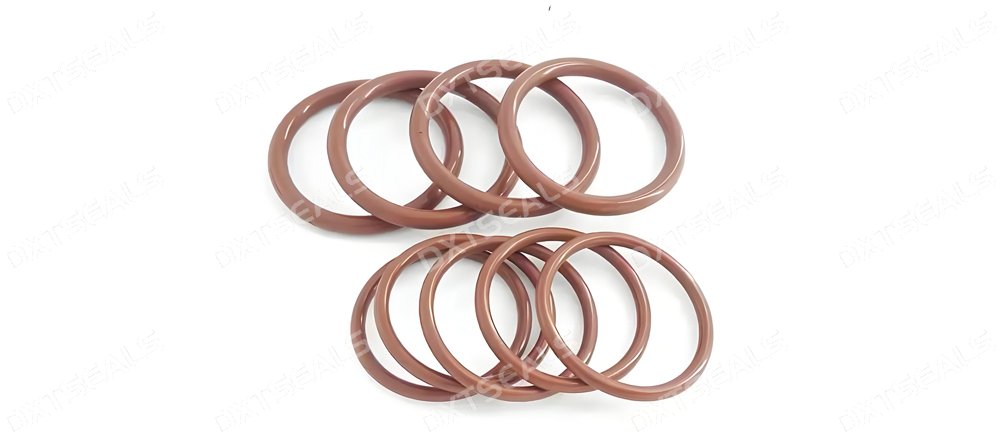
When manufacturing custom rubber seals—such as O-rings, flat gaskets, grommets, oil seals, or complex molded parts—the very first step is always the same: confirm the rubber material before starting mold production.
This step is not optional. It directly determines:
-
the accuracy of the mold
-
the overall project cost
-
the final product’s performance
-
the sealing reliability
-
the lifespan of the part
In this article, DXTSEALS explains the technical and economic reasons why early material confirmation is essential and how it influences every aspect of custom rubber molding.
1️⃣ Rubber Material Directly Determines Shrinkage Rate — Affects Mold Dimensions
Different rubber materials shrink at different rates during vulcanization.
This affects the mold cavity size and final product tolerance.
Typical shrinkage rates:
| Material | Shrinkage Rate |
|---|---|
| NBR | 1.5% – 2.0% |
| EPDM | 1.2% – 2.5% |
| Silicone (VMQ) | 2.5% – 4.0% |
| FKM | 1.5% – 3.0% |
| HNBR | 1.5% – 2.0% |
If you design a mold for NBR but later use Silicone, the final part can be 1–2 mm oversized or undersized, instantly causing sealing failure.
Molding precision starts with the correct shrinkage rate — which depends entirely on material.
2️⃣ Different Rubber Materials Require Different Mold Structures
Rubber materials vary in hardness, elasticity, and curing behavior.
These differences affect:
-
parting line design
-
venting structure
-
cavity support
-
mold strength
-
injection/compression pressure
For example:
-
Hard FKM or HNBR (80–90 Shore A) needs stronger cavity support.
-
Soft Silicone may deform easily and requires different venting.
If the mold is designed before confirming material, it may:
-
produce warpage or flashing
-
fail to fill properly
-
shorten mold life
-
require expensive rework
Correct material ensures correct mold engineering.
3️⃣ Material Affects Curing Behavior — Influences Production Stability
Rubber curing varies significantly between materials:
| Material | Curing Characteristics |
|---|---|
| FKM | High temperature, slower curing |
| Silicone | Fast curing, requires strong venting |
| NBR | Medium temp, stable curing |
| EPDM | Sensitive to temperature changes |
If curing assumptions are wrong, production defects will occur:
-
bubbles
-
incomplete vulcanization
-
dimensional inconsistency
-
deformities
Material confirmation ensures the mold matches the curing properties.
4️⃣ Material Choice Directly Impacts Product Performance
Each rubber has different chemical resistance, temperature capabilities, and mechanical strength:
NBR
Excellent oil resistance, economical.
FKM
High temperature + chemical resistance; premium choice.
EPDM
Best for steam, hot water, and outdoor environments.
Silicone (VMQ)
Extreme low/high temperature flexibility.
HNBR
High mechanical strength and wear resistance.
Using the wrong rubber material leads to:
-
swelling
-
cracking
-
hardness changes
-
premature failure
-
leakage
The correct choice must be made before mold production, not after.
5️⃣ Cost Structure Depends on Material Type
Material selection affects:
-
raw material price
-
waste rate
-
mold construction complexity
-
production cycle time
-
post-processing requirements
Cost differences can be significant:
-
FKM is 3–5× the cost of NBR
-
Silicone is 2–3× more expensive than EPDM
-
FFKM can be 20× the price of NBR
You cannot accurately quote mold or product cost without knowing the material.
6️⃣ Mold Making Cost is Affected by Material Properties
Material affects mold characteristics such as:
-
cavity finish
-
mold steel hardness requirements
-
number of cavities
-
expected mold life
For example:
-
FKM requires higher curing temperature → stronger mold materials → higher mold cost.
-
Silicone requires more venting → more complex mold structure.
Confirming rubber material early avoids unnecessary cost increases.
7️⃣ Changing Rubber Material After Mold Making Can Be Very Expensive
If the rubber type is changed after mold manufacturing:
-
mold dimensions may no longer be correct
-
cavity shrinkage compensation will be wrong
-
venting/injection structures may not be suitable
-
reworking the mold may not be possible
This often results in:
❌ additional modification cost
❌ new mold production
❌ delayed delivery
❌ unusable parts
Material confirmation is essential to prevent costly rework.
8️⃣ Required Steps Before Starting Mold Production (DXTSEALS Workflow)
Before mold making begins, DXTSEALS recommends these steps:
✔ 1. Confirm application conditions
Temperature, pressure, media, dynamic/static, environment.
✔ 2. Select rubber material
Choose among NBR, FKM, EPDM, Silicone, HNBR, CR, etc.
✔ 3. Determine hardness (Shore A)
Affects mold design and molding behavior.
✔ 4. Confirm shrinkage rate
Used to calculate final mold cavity size.
✔ 5. Approve 2D/3D drawings
Including tolerance and parting line.
✔ 6. Finalize mold process
Compression, injection, or transfer molding.
Once all these details are finalized, mold production can begin confidently.
⭐ Conclusion
Confirming rubber material before mold making is not just helpful — it is absolutely essential.
It affects:
-
overall cost
-
product performance
-
sealing reliability
-
mold accuracy
-
production stability
-
long-term durability
Skipping this step leads to dimensional errors, sealing failures, and costly rework.
By confirming the rubber material early, manufacturers ensure smoother production and better sealing performance.
For custom rubber components, engineering support, and full material selection guidance, DXTSEALS provides professional one-stop solutions.