
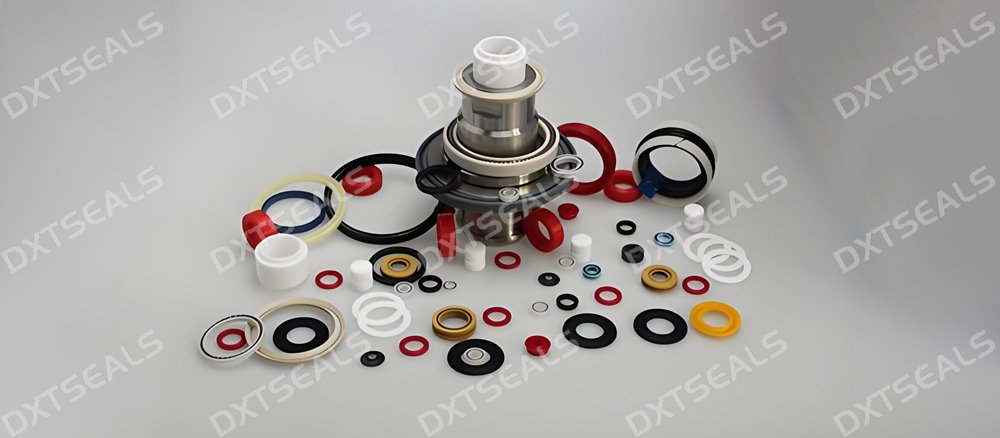
Spring Seals rely heavily on PTFE as the primary working material. While PTFE is widely used in hydraulic and pneumatic systems because of its low friction, chemical resistance, and temperature stability, not all PTFE materials behave the same in real applications.
Different PTFE formulations—pure, modified, and filled—exhibit different wear characteristics, creep resistance, and dynamic performance. These differences directly determine the service life, stability, and reliability of Spring Seals.
This article explains why PTFE material selection matters and outlines the key factors engineers must consider when choosing PTFE for sealing applications.
(Custom PTFE sealing solutions available from DXTSEALS.)
1️⃣ PTFE Material is the Core Factor Influencing Spring Seal Performance
The PTFE ring in a Spring Seal is responsible for:
-
withstanding dynamic friction
-
resisting extrusion under high pressure
-
maintaining shape under load
-
preventing wear and leakage
-
providing smooth, low-friction motion
Because PTFE takes the majority of the mechanical stress, the formulation you choose determines how long the seal will survive in real operating conditions.
2️⃣ Types of PTFE Materials Used in Spring Seals
1. Virgin (Pure) PTFE
-
No fillers
-
Lowest friction
-
Excellent chemical stability
-
Weak mechanical strength
-
High creep and deformation under pressure
Typical lifespan: Shorter in high-load or high-pressure environments.
2. Filled PTFE (Bronze, Carbon, Glass, Graphite, MoS₂, etc.)
Fillers significantly boost PTFE’s mechanical properties:
-
3–10× improved wear resistance
-
Higher compressive strength
-
Lower creep
-
Better extrusion resistance
Typical lifespan: Longest in heavy-duty dynamic applications.
3. Modified PTFE (e.g., PTFE+PFA, nano PTFE, special blends)
-
Better elasticity than filled PTFE
-
Improved fatigue resistance
-
Suitable for moderate pressure with high-frequency motion
Typical lifespan: Longer than virgin PTFE; stable for dynamic seals.
3️⃣ Key Factors: How PTFE Material Impacts Seal Life
The following PTFE characteristics determine how well a Spring Seal performs over time:
⭐ Factor 1: Wear Resistance
Seals in hydraulic cylinders, compressors, and actuators undergo continuous reciprocating motion. Poor wear resistance leads to:
-
scoring on the PTFE ring
-
leakage due to loss of sealing lip
-
faster seal failure
Material Comparison:
-
Virgin PTFE: ❌ Poor wear resistance
-
Modified PTFE: ✔ Moderate to high
-
Filled PTFE: ✔✔✔ Highest wear resistance
Wear resistance alone can extend seal life by 30–300%, depending on the formulation.
⭐ Factor 2: Creep and Deformation Resistance
PTFE is prone to cold flow (creep). Under pressure, poor-quality PTFE will:
-
deform
-
lose sealing contact force
-
extrude into gaps
-
eventually cause leakage
Best choices:
-
Glass-filled PTFE → very low creep
-
Carbon-filled PTFE → good structural stability
-
Bronze-filled PTFE → excellent under heavy loads
Virgin PTFE performs the worst in creep resistance, reducing seal life substantially.
⭐ Factor 3: Pressure Resistance and Extrusion Resistance
High pressure is a primary cause of seal failure.
If PTFE is too soft or too pure, it will:
-
extrude through the clearance gap
-
deform permanently
-
cause sudden seal failure
High-pressure recommendations:
-
Filled PTFE (glass, carbon, bronze)
-
Modified PTFE (for medium-high pressure)
Virgin PTFE is not suitable for hydraulic systems with pressures above 10–12 MPa.
⭐ Factor 4: Friction Coefficient and Heat Generation
Friction directly affects:
-
operating temperature
-
energy consumption
-
wear speed
Material Behavior:
-
Virgin PTFE → lowest friction
-
Modified PTFE → balanced
-
Filled PTFE → slightly higher friction but much stronger
If a system runs at high speed or long strokes, the wrong PTFE may overheat, accelerating wear.
⭐ Factor 5: Material Purity and Filler Quality
Impurities or poorly mixed fillers can cause:
-
uneven wear
-
material cracking
-
inconsistent sealing performance
-
brittle failure at low temperatures
High-quality PTFE blends ensure:
-
uniform material structure
-
predictable wear behavior
-
longer seal life
This is why industrial-grade PTFE from suppliers like DXTSEALS is important for critical equipment.
⭐ Factor 6: Lubrication Conditions
Seals often operate in:
-
insufficient lubrication
-
dry-running conditions
-
contaminated fluids
Filled PTFE provides superior performance in poor lubrication environments.
Virgin PTFE may fail quickly when lubrication is minimal.
4️⃣ PTFE Selection Guide Based on Working Conditions
| Working Condition | Recommended PTFE | Expected Seal Life |
|---|---|---|
| High pressure | Glass-filled PTFE | Long |
| Heavy wear load | Bronze-filled PTFE | Long |
| High-speed motion | Carbon-filled or modified PTFE | Long |
| Chemical exposure | Virgin PTFE | Medium |
| Low lubrication | Carbon-filled PTFE | Long |
| Precision motion | Modified PTFE | Medium-Long |
Choosing the wrong PTFE may reduce seal life by 50% or more, especially in high-pressure hydraulic systems.
5️⃣ Why DXTSEALS Provides More Reliable PTFE Spring Seals
DXTSEALS offers:
-
Full range of PTFE materials: virgin, filled, modified
-
Accurate material selection based on actual application loads
-
CNC-machined PTFE seals with tight tolerances
-
Industrial-grade fillers ensuring stable long-term performance
-
Technical support for hydraulic & pneumatic sealing systems
Our engineering team helps customers select the most suitable PTFE to maximize seal lifespan and reduce maintenance costs.
✅ Conclusion
PTFE material selection is one of the most critical factors affecting the service life of Spring Seals. The right material formulation determines:
-
wear resistance
-
pressure capability
-
extrusion resistance
-
thermal stability
-
durability under lubrication challenges
By understanding these factors and choosing the proper PTFE blend, you can significantly extend seal life and improve system reliability.
If you need a custom PTFE formulation or full sealing system support, DXTSEALS can help.